

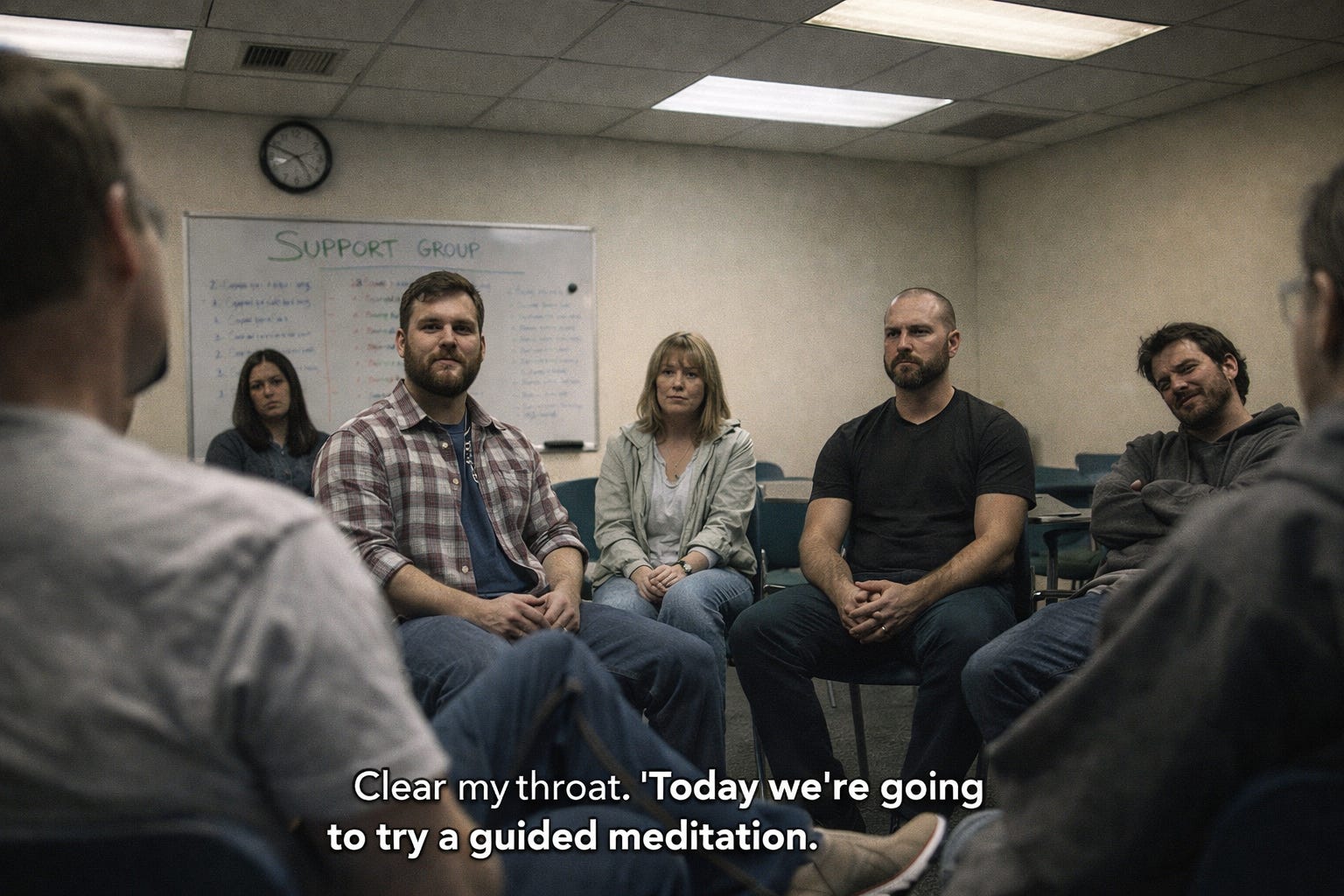
Let’s set the scene:
Fluorescent lights buzz overhead, the room smells like burnt coffee and anxiety sweat. You’re in group. Someone’s leg is bouncing like they’re trying to shake off a whole lifetime of nerves. The clock ticks. I clear my throat. “Today we’re going to try a guided meditation.”
Half the room groans. One guy stares straight ahead, jaw set. A woman looks hopeful, like maybe this is the day she finally figures out how to breathe again. In the corner, someone snorts—“Here we f*cking go.”
I’ve been all those people. The hopeful one. The skeptic. The one who’d rather do anything but “sit with my feelings.” If you’re already rolling your eyes, stay with me. I promise this isn’t what you think.
What Mindfulness Is (and What It’s Not)
Forget the Instagram filters and the monks in billowing robes. Forget the apps that chirp at you to “be present” while you’re stuck in traffic or elbow-deep in toddler puke. Mindfulness, in the real world, is simple but not easy:
Paying attention. On purpose. Right now. Without judgment.
Jon Kabat-Zinn, the scientist who hauled mindfulness into Western medicine, calls it “the awareness that arises from paying attention, on purpose, in the present moment, non-judgmentally.” Sounds tidy, right?
Except—let’s be honest—it’s often a mess.
Mindfulness has been packaged, marketed, and sold like diet pills. “Just breathe.” “Just be present.” “Just download this app and find inner peace in 3 easy steps.” But if you’re fighting cravings, memories, bills, or heartbreak, being told to “just sit with it” can feel like being handed a bucket with a hole in the bottom. You can pour and pour—nothing sticks.
Mindfulness isn’t a magic bullet. It won’t erase the shit you’ve been through. It won’t make your trauma pack up and leave. It’s not about becoming some perfectly zen version of yourself. Hell, I spill coffee on myself before 9 a.m. like a regular person. But sometimes—sometimes—it’s about staying in your body for one more second, even when you want to run.
Mindfulness For… (A Tour Through Every Kind of Brain)
The True Believers
You know these folks. Maybe you are one. Mindfulness is their oxygen. They found it in a therapist’s office, in the quiet after a panic attack, in the stillness that finally let them breathe. “This saved my life,” they say, and you can see it in their eyes—they mean it. For them, mindfulness is how they stopped running, how they learned to hear their own heartbeat again.
Scene: A guy sits cross-legged, palms up, tears running down his face, and for the first time in years, his shoulders drop. “I didn’t know I could feel this calm,” he whispers.
The Skeptics & Haters
Maybe this is you. Maybe you’re reading this and thinking, “I need a drink, not a mantra.” Mindfulness? F*ck that. You want to move, to do something, anything but sit still with your mess. For some, the whole thing reeks of privilege—like it’s made for people with time, money, and no real problems.
Try telling someone who’s survived hell to “just breathe.” Sometimes, mindfulness sounds like gaslighting. You’re not “escaping.” You’re surviving.
Scene: You’re sitting in a circle, fists clenched, checking the clock. The leader says, “Notice your breath.” You want to scream, “I notice it. It’s fast. I want out.”
The Intellectualizers
Some people try so hard to “be mindful,” they turn it into a science project. You close your eyes. Your brain says:
Am I doing this right?
Why does my back hurt?
Did I pay that bill?
What’s the point of this, anyway?
You analyze every breath, every sensation, until you’re more stressed than when you started. For you, mindfulness is just another thing to fail at.
Scene: You’re three minutes into a body scan, and you’re already writing your to-do list in your head. Welcome to the club.
The Neurodivergent
Here’s a fact: Not all brains are built for stillness. ADHD, autism, trauma—sometimes sitting still feels like a punishment. For you, mindfulness might mean movement: pacing, rocking, humming, drumming fingers on the table. You need rhythm, not silence.
Scene: I had a client who could only “meditate” when she was walking—up and down the hallway, over and over. That was her anchor. Forget the cushion. Give her sneakers.
The Good Old Boys
Meet the “ain’t nothing wrong with me” crowd. Mindfulness? That’s for hippies. But watch them fix an engine, hunt in the woods, chop wood, or work with their hands. Watch how the world falls away. That’s presence. That’s mindfulness—but nobody’s calling it that.
Scene: Grease on your fingers, country music in the background, mind empty except for the work in front of you. That’s it, right there.
The Criminalized & Traumatized
For some, silence isn’t safe. Sitting still is a trigger. The last time you were alone with your thoughts, something bad happened. You find presence in noise, in chaos, in movement. Maybe it’s music blasting in your headphones. Maybe it’s cleaning at midnight or running until your lungs burn.
Scene: You’re mopping floors at 2 a.m., lost in the rhythm, finally able to breathe.
The Rest of Us
Most of us are somewhere in the middle. You’re just trying not to lose your shit in the grocery store. Your version of mindfulness might be turning up the music, feeling the steering wheel in your hands, or noticing the taste of coffee before you rush off to the next fire.
Scene: You sit at the kitchen table, sunlight through the window, and for one second, you actually taste your breakfast. That’s mindfulness, too.
The Science—and the Shit They Don’t Tell You
Let’s talk research—quick, real, not too heavy.
Mindfulness can rewire your brain. Studies show it reduces anxiety, depression, and even changes the structure of your grey matter. (Holzel et al., 2011; Goyal et al., 2014.) Bessel van der Kolk says mindfulness can help trauma survivors reclaim their bodies.
But here’s the kicker: For some, mindfulness increases anxiety. (Van Dam et al., 2018.) If your body’s a haunted house, being “present” can mean facing every ghost at once. Mindfulness isn’t a panacea. It’s a tool. Sometimes, it’s the wrong tool for the job.
Humanistic clinicians—Carl Rogers, Irvin Yalom, Gabor Maté—say what matters most is connection. Sometimes “just being present” isn’t enough. Sometimes you need a hand to hold, a voice to ground you, a rhythm to move you through.
What Actually Works: Real-World Mindfulness, Uncensored
Let’s get weird. Let’s get real.
Maybe you hate sitting still. Try sound healing—let the bass thump through your bones. Try binaural beats—let your brain follow the waves. Try a walking meditation—left, right, left, right, until your thoughts blend into the rhythm of your feet.
Or close your eyes and let someone guide you. I used to take people on journeys in group:
Picture a field, golden and wild. The air smells like summer. You walk, sun on your face, grass brushing your legs. You find a trail, follow it to a creek, cold water slipping over rocks. Put your feet in. Listen to the birds. Feel the ache in your chest loosen, just a little. When you’re ready, come back.
That’s mindfulness. That’s presence. No app required.
If you’re skeptical, start small. Notice the taste of your coffee, the feel of your sheets, the sound of your own laughter. If you’re restless, move. If you’re scared, bring an anchor—a friend, a song, a scent that grounds you.
If you hate being alone with your thoughts, let someone else’s words hold you steady. Call a friend. Listen to a podcast. You don’t have to do it alone.
The Only Rule is There Are No Rules
Here’s the truth: Progress is progress. There’s no right way to do mindfulness. You don’t have to buy the whole package. You don’t have to become a sage on the mountain.
Take what works. Leave what doesn’t. Screw the rest.
Try this, tonight: When you’re brushing your teeth, pause. Notice the taste of the toothpaste, the sound of the water, the way the bristles feel. Let yourself be there, just for a second. That’s mindfulness. No incense, no chanting, no bullshit.
If you find yourself, even for a moment, in your own body, in your own life, in your own mess—you’re doing it right. Even if your “present moment” is a goddamn trainwreck, it’s yours. That’s all it ever had to be.
Mindfulness isn’t about fixing yourself. It’s about showing up. And sometimes, showing up is the bravest, most badass thing you can do.
So whether you’re chanting “om” or screaming “fuck this,” whether you’re sitting still or running wild, just remember: you’re here. You’re alive. And that, my friend, is enough.
Progress is progress. Don’t let anybody sell you anything different.
Now go—try it. Taste your life, even if it’s gritty, even if it’s weird, even if it’s only for a breath.
I love this take on mindfulness. You keep it simple as it should be. And absolutely it can look like all of those things you describe. The thing is, is to just be present in whatever you are doing. I have also described being mindful in brushing my teeth as an example. Or eating, to actually taste the foods, hear the crunching, etc.
My favorite is driving my jeep with the top off and feeling the wind in my hair and on my face. No radio, just me and good old Betsy the Beast (my jeep's name, lol.) My favorite is to drive her through any kind of nature setting. It settles my soul.
Another favorite is when I get to wake up naturally, no alarm, and immediately hear the birds chirping outside my window and can feel the sun peaking through my blinds covering the windows.