

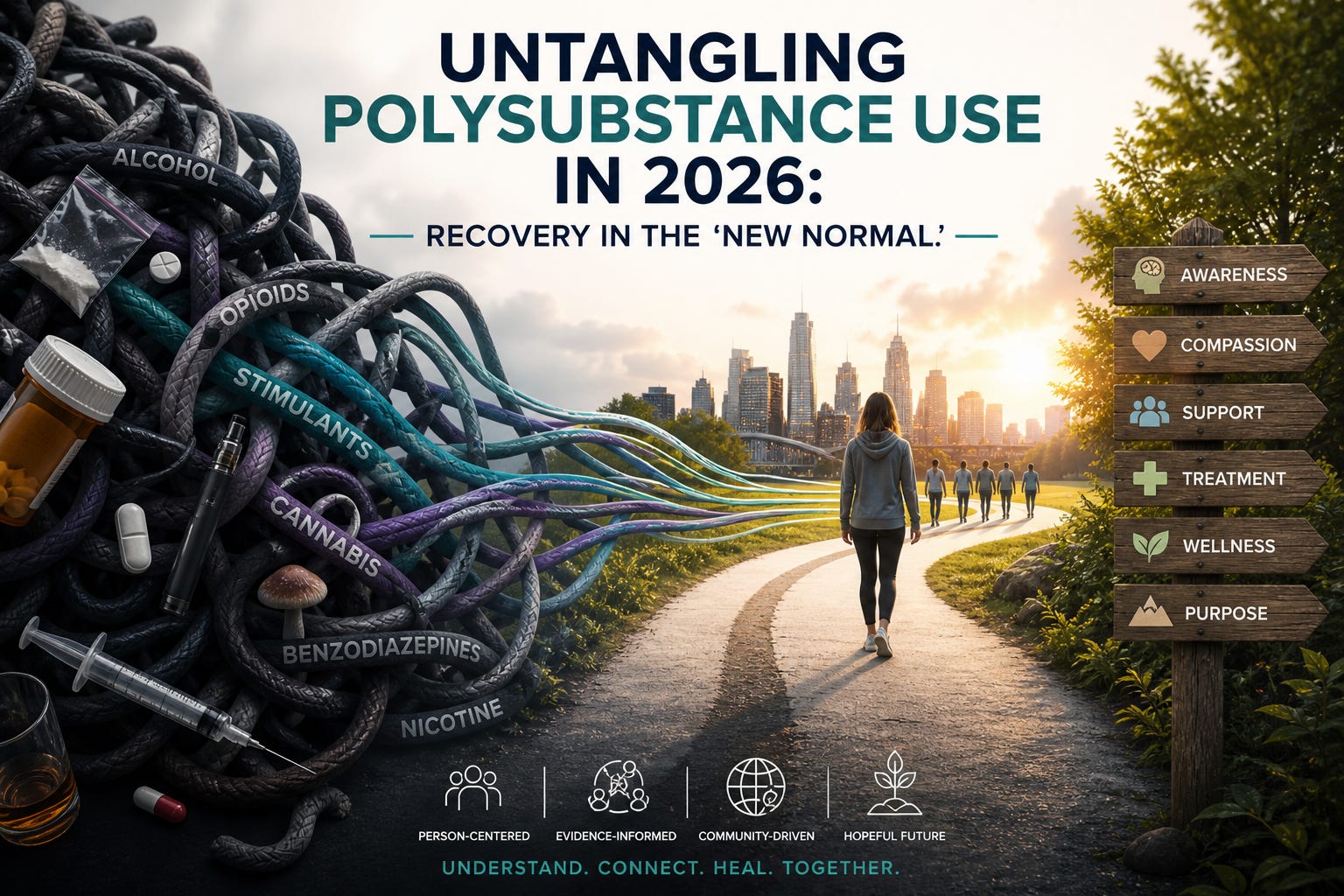
Clients in my Wisconsin practice don’t come in asking about just one drug anymore. More often, they describe layered daily routines: high-potency cannabis to start the day, a “harmless” counterfeit pill for focus or sleep, and weekend mushroom experiences that sometimes spiral. These substances don’t stack neatly—they wrap around each other like vines tightening on an old tree, slowly reshaping everything underneath.
This is polysubstance use in 2026: the blending of multiple drugs, whether intentional or accidental. It has become the dominant reality across America—from Portland and Denver in the West, to Northeast cities, rural Midwest communities, and major Southern centers. The specific substances may vary by region, but the tangled impact feels remarkably consistent.
Fentanyl-laced counterfeit pills (often indistinguishable from real prescriptions), a sharp rise in psychedelic use, and ultra-potent cannabis (routinely 25–30% THC or higher) form the core combination. Local “flavors” differ, but the complexity is nationwide.
So what does this evolving landscape mean for people who use, the families who love them, and the professionals trying to help? Let’s skip the doomsday talk and oversimplifications. It’s complicated—but real hope exists too.
The Changing National Landscape
We’re now deep in the “fourth wave” of the overdose crisis, defined by polysubstance involvement. The majority of overdose deaths now involve multiple substances. Regional patterns stand out: fentanyl-meth combinations dominate out West, while cocaine-fentanyl mixes (sometimes with xylazine or benzodiazepines) are more common in the Northeast. The Midwest and South reflect a patchwork of both.
Counterfeit pills circulate everywhere. Psilocybin mushroom seizures have risen dramatically nationwide. High-potency cannabis—whether in legal markets or illicit channels—often serves as the amplifying baseline, intensifying the effects of whatever else is in the mix.
The practical result? Messier withdrawal, unpredictable interactions, and treatment approaches that no longer fit neatly into traditional single-substance models. It’s like trying to repair a car with several critical systems failing at once. Fixing only one rarely gets the vehicle back on the road.
How Polysubstance Use Feels for the Person Using
Clients often describe it as hiking a long trail while carrying several heavy, shifting backpacks—whether they’re in the Rockies, the streets of Philadelphia, or a quiet Wisconsin town. The weight compounds.
What starts as cannabis for relaxation can quietly expand to pills for energy or mushrooms for escape. The combinations create new, unforeseen problems. Risks become far less predictable. Something that felt manageable last month can turn dangerous with one new addition. Recovery feels overwhelming because there isn’t one clear target—cravings for one substance easily trigger another. Many don’t even see themselves as “addicted” since no single drug dominates the story.
Yet progress is absolutely possible. Stability in one area—such as medication-supported management of opioids—can create breathing room to address the rest. Like carefully clearing one vine at a time, light begins to reach the parts of life that have been struggling in the shadows.
What This Means for Families and Loved Ones
Families across the country—from Wisconsin suburbs to Southern Appalachia to Los Angeles neighborhoods—use the same word: exhausted.
The goalposts keep moving. Just as you adapt to one substance, another enters the picture and everything changes again—the symptoms, the dangers, and the conversations. It’s incredibly difficult to know when to step in, what truly helps, or how to communicate without pushing your loved one away. The cycles of crisis, brief hope, and setback wear down even the strongest support systems.
Many describe it as watching someone drown while desperately handing over different life preservers, never quite sure which combination will keep them afloat.
The path forward isn’t simple, but practical steps help: learning about naloxone for unexpected fentanyl exposure, staying informed on regional risks, and finding ways to offer support that don’t unintentionally enable use.
Implications for Professionals
For counselors, physicians, therapists, and recovery coaches, this shift demands adaptation. Old single-substance detox and abstinence models fall short—whether you practice in progressive California, conservative Wisconsin, or anywhere in between.
We need updated assessment tools, more sophisticated withdrawal management, and therapy that addresses how substances reinforce one another. Harm reduction strategies—fentanyl test strips, honest education, and safer use practices—have become essential bridges to deeper recovery work.
In rural Wisconsin, where I practice, resources are often limited. Colleagues in the South face similar constraints, while providers in cities with legal cannabis or emerging psychedelic access navigate different integration challenges. The work is harder everywhere, but the reward—watching someone begin to clear their own vines and stand stronger—is profoundly meaningful.
The Future of Recovery
The silver lining is a move toward more realistic, holistic care. Recovery is increasingly viewed less as a single turning-point surrender and more like ongoing management of a chronic condition—similar to diabetes or heart disease. Consistent support, integrated mental health and trauma care, housing stability, and community connection are becoming essential.
Prevention must focus on delaying early exposure, especially among youth whose developing brains are particularly vulnerable to these layered patterns. Regional innovations that prove effective will need to spread more quickly across the country.
People do recover. The “how” simply looks different in 2026 than it did a decade ago—and it will continue evolving.
A Simple Image to Hold Onto
Picture an old tree strangled by vines—its growth stunted, its needs ignored. That’s polysubstance use in America today. But with the right tools, steady support, and time, those vines can be untangled. The tree can thrive again.
Whether you’re working on your own use, supporting someone you love, or helping clients as a professional—you are not alone in this complexity. My clients navigate it every day, and I’m right there with them.
How has polysubstance use shown up in your life, family, or practice? Drop an honest comment below. These conversations matter, and I read every one!
Such a good perspective! 🙂 Thank you.