

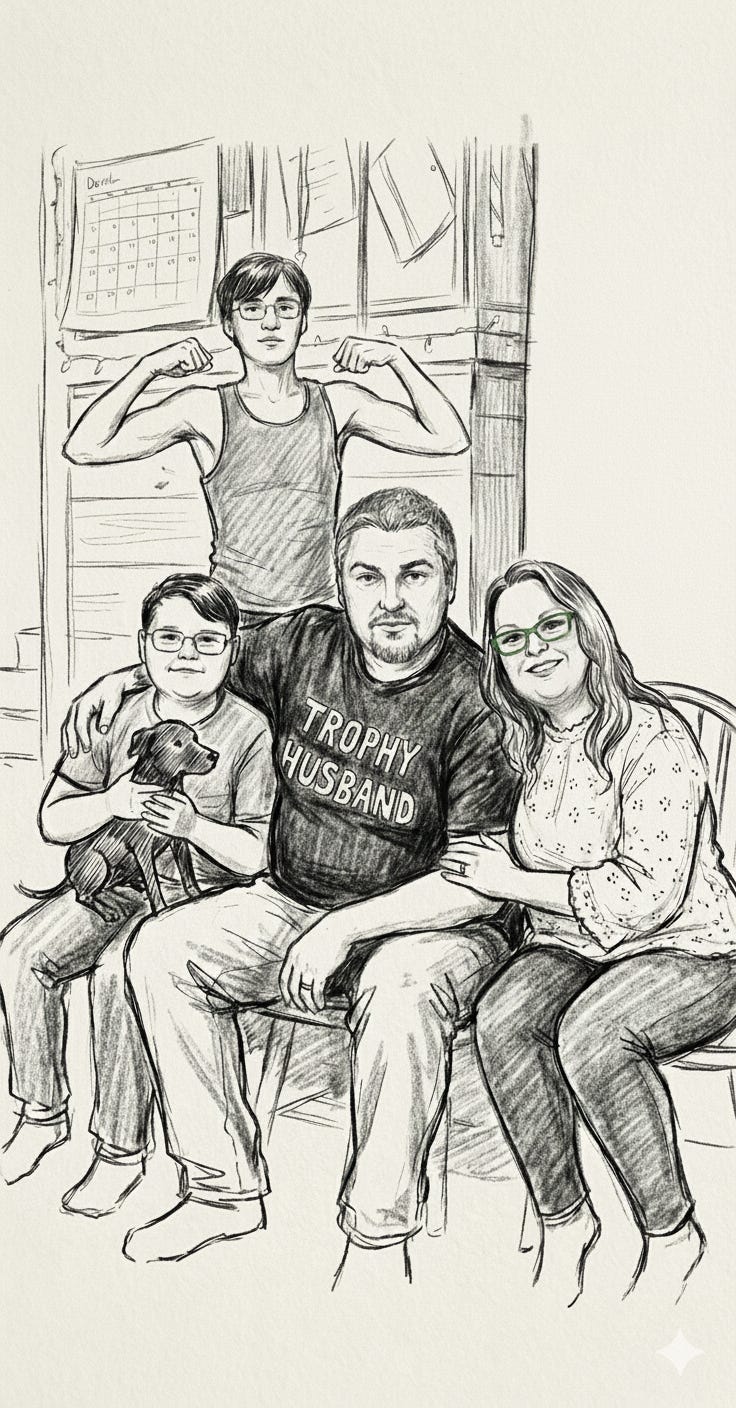
There’s this moment that happens right before you make a big change—something so big it could rearrange your whole family. It doesn’t feel like Braveheart music swelling in the background, or like the scene in the movie where everybody cheers as the hero storms the castle. It feels more like late-night scrolling through photos you haven’t looked at in years. It feels like breathing so slow and shallow you’re not even sure if your body’s really taking in air. It feels like your stomach trying to gnaw a hole through itself.
That’s where I am today, the day before court. Court for terminating my kids’ biological father’s rights, court for letting my husband—the man who’s been their dad in the ways that actually count—adopt them for real, for legal, for forever.
I’ve written about co-parenting before. I’ve written about addiction, grief, recovery, therapy, relapsing into self-doubt, wrestling with my own triggers. I’ve spilled way too much raw truth on this blog sometimes, and gotten messages at 2 a.m. from parents or moms like me, telling me my story could have been theirs. But I have never been in a moment like this before. It’s bigger, messier. It’s everything at once—freedom and terror, grief and hope, and mostly, exhaustion. The kind of heart-tired you don’t know how to sleep off.
The Weight of Goodbyes, and the Ghosts of “Could Have Been”
I thought I was done losing it, but this week’s been a greatest hits reel of nostalgia and regret. I’ve found myself pulling out old photos—the messy ones, the awkward birthdays, the ones where you catch yourself actually hoping things might turn around. I don’t even know what I’m looking for. Probably closure. Maybe a way to believe that this isn’t just the end of something, but the start of something else.
There’s no perfect parenting soundtrack for this kind of thing. There’s just the low white noise of the TV in the other room, and the weird electricity in the air the day before court. I can feel it in my bones. My kids know it’s coming, too, whether they say it or not.
Kids Always Know More Than We Think
Here’s the piece that slices me up: my youngest, eleven, comes to me a few nights ago and says, with this blunt calm only a kid who’s been through too much can have, “I don’t think my dad is ever going to change. He’s been to prison twice, and he’s still doing the same stuff. He doesn’t do what he says he’s going to.”
It knocked me back, honestly. On one hand—validation. My kids get it. They’re not just swallowing the grownup lies I wish I could feed them, the ones we use to shield kids. They’re facing the truth, the same way I have to. But it’s also the sharpest heartbreak, knowing my kid has learned the lesson—that sometimes people don’t change, that sometimes love isn’t enough—way before he should have. What kind of world does that force a kid to live in? How do I forgive myself for the fact that my son had to grow up sturdy in the face of disappointment?
And still, here he is, sitting on the bed, asking about what happens next, and if this means things can finally settle down. Hope, even after all of it.
My Husband’s Love Letter to the Kids
Let me tell you what makes me lose it in a completely different way: watching my husband, the man who didn’t have to be here, sit with my kids this week and talk them through what’s coming. No judgment, no pushing, just holding space. The talks are gentle. He doesn’t ask for them to pick sides or promise things will be picture-perfect. He just promises to show up for them for real—not just as their legal parent, but as the one who’s there when the light blows in the hallway at 10 p.m., or when someone needs to know how to fix this or that, or when the world feels scary and you need someone steady to stand beside you.
They love him already. I see it written on their faces, the way their bodies relax around him, the way my Son lights up when he hugs him. It doesn’t feel forced. Watching that, I realize how much work it has been—this long, hard, messy path to stability. It’s not just me, it’s all of us, trying to build something solid out of splinters and duct tape and sheer will.
Honestly, those moments are like a real exhale. There’s so much we’ve all carried for so long, and then to see them safe enough to hope for something, to want it, to be excited—it blows a little clean air straight through the stuck places in me.
The Book We Wrote, and How We Keep Creating Our Own Story
Earlier this year, my son and I wrote a book together—The Circle Stays Unbroken. It might seem small, a family project or a therapy tool. To us, it was a lifeline. Sitting together and putting down our story, the pain, the hope, the weird in-between of loving someone and letting go, it stitched up some torn places for both of us. I remember reading the first draft aloud to my family while they sat behind me on the bed, voice shaking, not sure what I’d hear when I finished.
My son just grinned. “Mom, this is amazing. What’s the next book going to be about?”
He wasn’t stuck in the old stuff. His first thought was the next chapter, the future. Sometimes, it’s kids who teach you what resilience actually looks like—and show you there’s more story even when you think the narrative’s over.
What Tomorrow Feels Like: The Mess and the Ritual
I don’t know exactly how the morning will go. I know that the TV’s going to be on, because we always leave it on during stressful mornings, like background music to drown out anxious thoughts. I know my hands are gonna shake while I’m getting ready to head out the door. Mutts underfoot, everyone a little on edge, everyone trying to pretend we’re not.
This energy, this knot in the chest, it’s familiar—the kind of thing that happens any time there’s a battle for or about your kids, and something in you is terrified you’re going to lose, no matter how right you are, no matter how hard you fought. That courtroom is where all the ghosts of old hopes hang out. Every time I step inside, I remember the first time, years ago, believing this would all end quickly. It never does.
If my ex shows up—that’s a whole different kind of storm. There’s a part of me that wants to act a fool, let all the things I’ve never been able to say spill out and crash all over the stillness of the court. But then there’s the part of me that knows I can’t do it—not just because of the judge, not just because I’m an adult, but because my kids are watching. And I want to break the cycles, not feed them.
Recovery Mode: Raw, Unfiltered, and Human
Here’s a thing I think about a lot: what would I really say to myself, if I didn’t have to play the “put-together” adult or professional? Honestly? I’d probably be screaming: “Just fuck it. Turn it all off. No emotions, no feeling. Just armor up and survive the day.”
But that’s not how recovery is supposed to work. That’s not the lesson I want my clients, my kids, or myself to walk away with. As a counselor, I preach being present, feeling the feelings, letting the hurt breathe so it stops rotting you from the inside out. As a human? I still want out sometimes, want to bury it, numb out, escape the pain by any means necessary.
It’s a joke, kind of, how long it takes to trust yourself again in recovery, even after years. Parenting only multiplies that confusion. I want to be the calm, wise, always gentle parent—but the truth is, sometimes I want to throw plates (metaphorically), or hide in the laundry room until court is over.
Modeling Vulnerability (Even If It’s Messy)
My kids see more than I want them to. My husband and I, we don’t try to keep it all tucked away. We talk about what’s happening, we check in. I’d love to say I’m a ninja at hiding my nerves, but the truth is, my hands shake, my voice gets clipped, and my patience runs thin. But my kids don’t crumble because of that—they trust me more because I show up anyway. They know this isn’t easy, but we walk through it together, even if I’m not always stoic or strong.
If there’s a lesson in all this, it’s that “modeling behavior” for your kids doesn’t mean being perfect. It means letting them see you struggle, own your shit, and still move forward. It means apologizing when you mess up, and letting your family watch you stand back up, even if you’re knee-deep in fear.
Hope and Grief, All Tangled Up
If I’m honest, I don’t know if tomorrow will bring relief or another cliffhanger. Maybe my ex won’t show. Maybe we’ll finally get the “release” we’ve waited for—the legal signoff that says yes, this is your family for real, and you don’t have to fight anymore. Maybe my kids will finally get the solid ground they’ve been waiting for since forever.
But grief comes with hope. There’s always going to be the ache for what could have been, always going to be a wish that the man who gave them life could have shown up differently. Sometimes, the healthiest thing you can do is admit that may never happen, and let the rage and grief have their own space—without letting it poison what you’re building now.
Recovery is never neat. Parenting even less so. All I know how to do is put one foot after the other, take the next honest breath, keep grinding until “normal” doesn’t feel like a pipe dream anymore.
To Anyone Who Needs to Hear It
I know there are people out there reading this who are smack in the middle of their own family chaos. Maybe you’re staring down court documents, or wrestling with co-parenting with someone who keeps letting you down, or trying to figure out how to show up for your kids when you’d rather be hiding under the covers. If nobody else has told you this lately: brave isn’t big. Sometimes it’s just survival. Sometimes it’s holding your kid while you both cry. Sometimes it’s showing up to a courtroom full of ghosts, ready to lose your mind—but you keep yourself together anyway, because your family is worth it.
None of us are superheroes here. Recovery isn’t straight lines, and neither is parenting. We mess it up. We start over. We admit when we’re scared. And if there’s anything I hope my kids learn from this, it’s that you don’t have to have it all figured out to be “enough.” You just have to keep showing up.
Tomorrow is a big day in my house. Maybe it’ll be the start of peace, of stability, of being able to finally set down some of the weight. Or maybe it’ll be another detour, another “not yet.” Whatever happens, I’ll write the next chapter alongside my kids, hand in hand, the way we’ve always done it.
And if you’re reading, and you’re scared, and you’re tired, and you wish you could turn it all off—don’t. Let yourself feel it, even if you feel like you’ll break. Because at the bottom of all that rawness, there’s still hope. There’s still family. Even when the circle isn’t neat, the circle stays unbroken.
See you on the other side.
– Belle
This holds the reality that some decisions are both protective and grief-laden at the same time. The courage here is not loud or triumphant. It shows up as restraint, presence, and the willingness to carry complexity without forcing resolution. Court is framed not as victory, but as a threshold where past, present, and future all press in at once.
What stands out is how recovery and parenting intersect in the refusal to numb or armor over. Letting children see steadiness alongside fear models something durable. Stability is not portrayed as perfection, but as consistency, honesty, and showing up again after being shaken. That kind of ground is built slowly, and it lasts.
You got this!