
Progress Over Perfection Course Session 5
Session 5: Progress In Real Life 👊🏽🚶♀️🌱

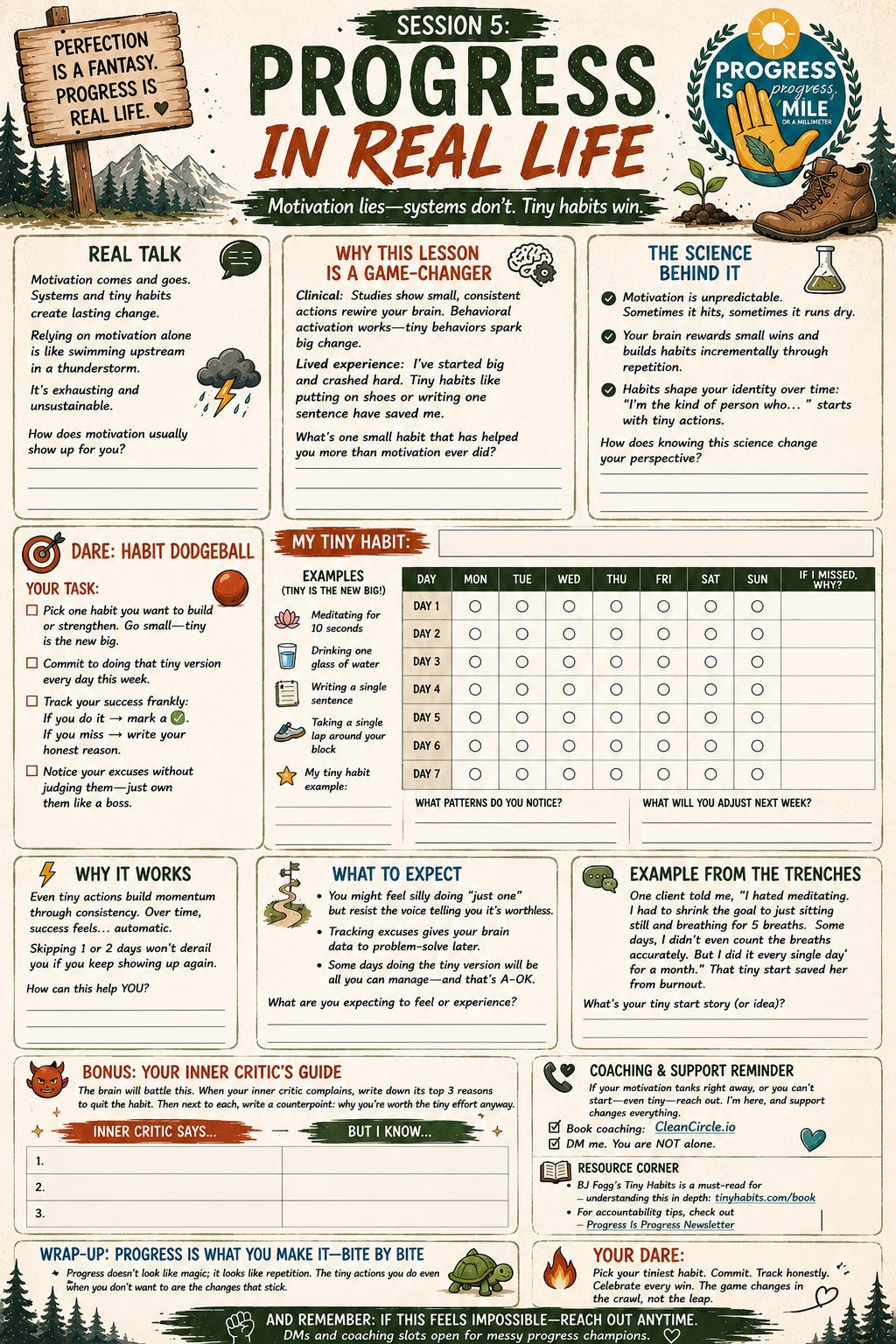
Motivation Lies—Systems Don’t 🎭🛠️
You want change. You feel fired up. You make the big plan, pump yourself up with motivation… and then life happens. Motivation disappears like morning fog, and you’re left wondering what went wrong again.
Here’s the truth most gurus won’t tell you: Motivation is unreliable. It’s emotional weather—sometimes sunny, often stormy. Relying on it alone is like trying to swim upstream in a thunderstorm. Exhausting. Unsustainable. Doomed to fail.
Real, lasting progress comes from systems and tiny habits—the quiet, consistent actions you take even when you don’t feel like it. This is the shift that separates people who stay stuck from those who actually move forward in recovery, mental health, parenting, and life.
Welcome to Session 5 of the Progress Over Perfection series. We’ve unplugged shame, interrupted self-sabotage, and now we’re getting practical: how to make progress when motivation ghosts you.
Why This Lesson Is a Game-Changer 🧠⚙️
Clinically, this is backed by solid science:
Habit formation research (including BJ Fogg’s work) shows that small, repeatable behaviors rewire neural pathways far better than big, motivation-fueled efforts.
Behavioral activation—one of the most effective therapy techniques for depression, addiction, and anxiety—starts with tiny actions to build momentum and dopamine naturally.
Motivation fluctuates. Systems create automaticity.
From my own trenches: I’ve crashed and burned with “all-or-nothing” plans more times than I can count. What actually saved my recovery and my sanity? Starting stupidly small—putting on shoes to walk around the block, writing one honest sentence in my journal, taking one deep breath when everything felt overwhelming. Those micro-moves kept me going when willpower was nowhere to be found.
The Science Behind It 🔬
Motivation is unpredictable — It comes and goes. Waiting for it keeps you paralyzed.
Your brain loves small wins — Each tiny success releases dopamine and builds the “I’m the kind of person who…” identity.
Repetition creates identity — You don’t rise to the level of your goals. You fall to the level of your systems (shoutout to James Clear).
Tiny habits compound. One glass of water becomes better hydration. One lap around the block becomes movement. One honest sentence becomes clarity. Progress isn’t magic—it’s repetition.
For parents and those shaping young minds: Kids don’t need perfect role models. They need to see us doing the small, consistent things. When we model “I’m just going to sit and breathe for 30 seconds” or “I’m writing one thing I’m grateful for,” we teach them that progress is accessible, not overwhelming. Generational change starts with us choosing systems over sporadic motivation.
DARE: Habit Dodgeball 🎯🏐
This exercise is dead simple and ridiculously effective. No perfection required.
Your Task:
Pick one tiny habit you want to build or strengthen. Go ridiculously small.
Meditate for 10 seconds
Drink one full glass of water
Write one single sentence
Take one lap around your house or block
Put on workout shoes (that’s it—no workout required)
Commit to the tiny version every day for the next week.
Track it honestly:
✅ = Done
If you miss it, write the real reason (no judgment): “Exhausted,” “Forgot,” “Kids needed me,” “Phone died.”
At the end of the week, review without self-criticism. Just notice.
Bonus — Inner Critic Tamer 👹📉
When your brain says “This is too small to matter” or “You’ll never keep this up,” write its top 3 complaints. Then write a counterpoint for each. Example: “This is pointless” → “Tiny actions are how every big change actually happens.”
Pro tip for families: Do a family version. Everyone picks one micro-habit. Celebrate together at dinner. Makes it fun and models the process.
Why It Works 💥
Tiny habits bypass overwhelm. They build momentum, rewire your identity, and create data you can actually use to improve. Missing a day or two won’t break the chain if you just get back to the tiny version. Consistency > intensity.
What You Might Feel 🛤️
Silly doing something so small (“This can’t possibly count”)
Relief when you realize you can succeed daily
Frustration on off days—use it as information, not proof you’re failing
Growing pride as the ✅s stack up
Important: When Motivation Tanks Completely 😳🆘
If you can’t even start the tiny version, or old patterns flood back hard—stop and reach out. This isn’t weakness; it’s wisdom.
Book confidential coaching or counseling at progresscounselingprograms.com
DM me anytime. You are not alone.
Resources for You 📚🕯️
Must-Watch Videos (evidence-based & inspiring):
Forget Big Change, Start with a Tiny Habit: BJ Fogg at TEDxFremont The gold standard. Watch this and you’ll never look at habit change the same way again. Watch here
Atomic Habits – How to Build Habits That Stick (James Clear) Powerful breakdown of systems over motivation. Watch here
How to Build Systems To Actually Achieve Your Goals – James Clear Excellent for recovery and real-life application. Watch here
My book: Progress is Progress: Codependency Workbook – Tools, Truths & Tiny Steps to Start Your Healing Journey by Belinda “Belle” Morey Available on Amazon
BJ Fogg’s Tiny Habits resources: tinyhabits.com
Wrap—Progress Is What You Make It—Bite by Bite 🍰🐢
Progress doesn’t look like overnight transformation. It looks like showing up in tiny ways, even when you don’t feel like it. Those small, honest actions are what actually stick.
🔥 Your Dare: Pick your tiniest habit today. Commit. Track honestly. Celebrate every single win—no matter how small. The game changes in the crawl, not the leap.
You’re already further along than you were yesterday. Keep it real. Keep it moving.
👊 Progress is Progress. Reaching out is power. I’m here for the messy, beautiful journey.
Share in the comments: What tiny habit are you committing to this week? What’s one excuse you’re ready to notice without judgment? Let’s cheer each other on.
See you in Session 6. 💪