
Progress Over Perfection Course Session 4
Session 4: Shame Unplugged 🕳️💥🗣️

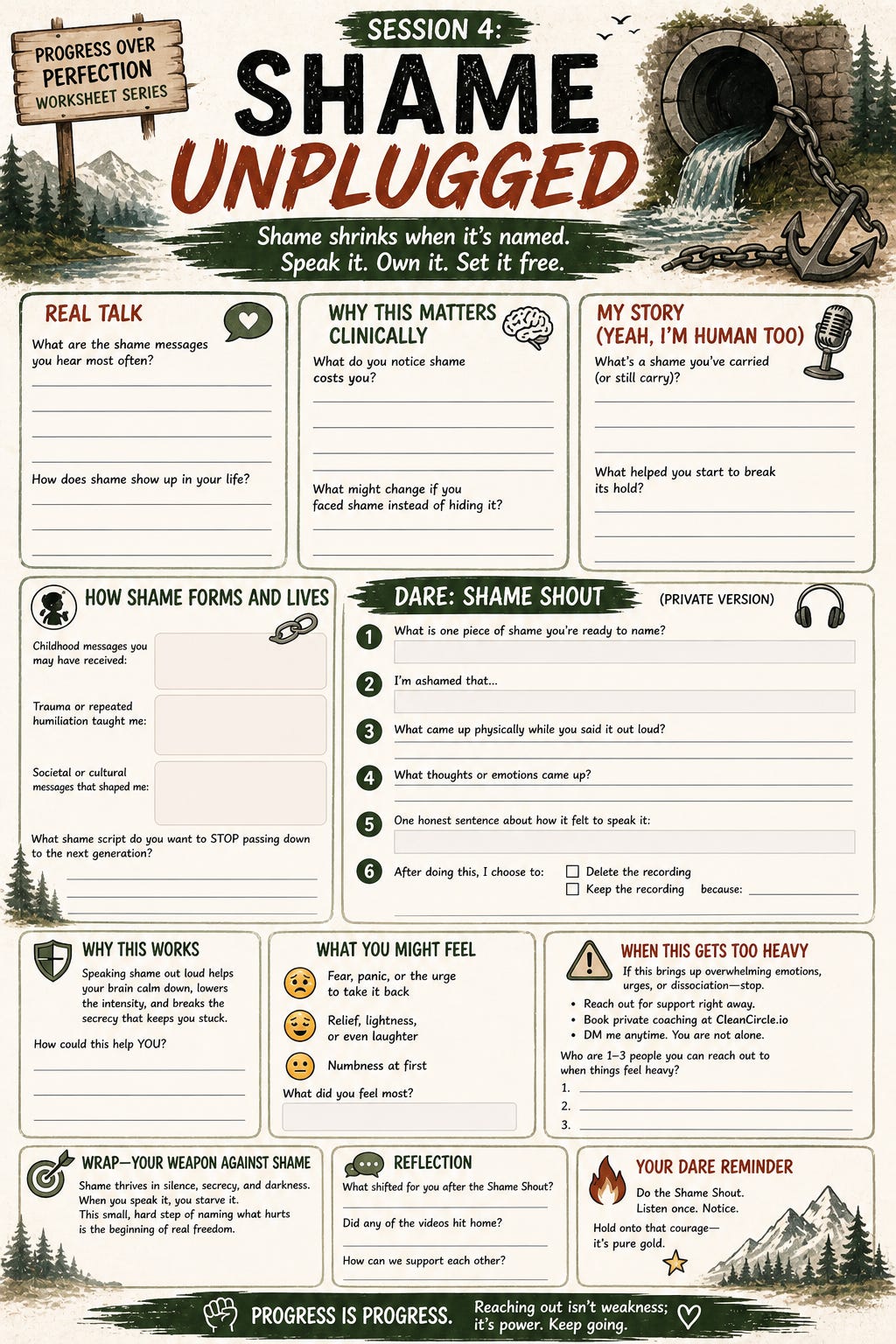
Shame Is the Sewer Pipe We Drag Behind Us 💔🐍
Shame is brutal. It’s that low, constant rumble beneath everything—the voice that whispers, “You’re not good enough,” “If they really knew you, they’d leave,” and “You are the problem.”
In recovery and everyday life, shame is a silent killer. It fuels relapse, mental health spirals, self-sabotage, and crushing isolation. Your shame tells you to stay silent, stay alone, and stay stuck exactly where you are.
But here’s the liberating truth: shame shrinks when it’s named. Speaking it—even just to yourself—pulls it out of the shadows and into the light where it can’t control you anymore.
This is Session 4 of our Progress Over Perfection course. If you’ve been with us through the Lie of Perfection, Redefining Progress, and Ugly Wins, you already know we’re building something real here: a path that honors messy humanity instead of demanding flawless performance. Shame is the hidden anchor holding so many of us back. Let’s unplug it.
Why This Matters Clinically 🧠⚠️
Shame isn’t “just a feeling.” It’s wired deep in our biology:
It lights up the same brain areas as physical pain. That’s why it hurts so damn much—like a punch to the gut that lingers for days.
Chronic shame builds isolation, depression, anxiety, and relapse cycles. It keeps you numbing out or hiding instead of healing.
Naming shame aloud calms your nervous system’s alarm bells. It reduces the intensity, builds real connection, and interrupts the secrecy that keeps the cycle alive.
In my work with clients (and from my own lived experience), I’ve seen shame as the common thread in addiction, trauma, codependency, and even “high-functioning” burnout. Unaddressed, it sabotages progress. Faced head-on, it becomes fuel for freedom.
My Story (Yeah, I’m Human Too) 🤫🎤
Even years into recovery, I still battle crippling shame around things I “shouldn’t” feel ashamed of—random relapse urges that pop up, parenting moments I wish I could redo, messy relationship patterns from the past. It feels like a shadow that tags along no matter how much education or awareness I gain.
What changed everything for me? Saying it out loud. First in the mirror, then in therapy, then with safe people. Each time, the voice got quieter. The grip loosened. I stopped being defined by it.
You don’t have to be “fixed” to start this work. You just have to be willing to get honest.
How Shame Forms and Lives 👶🔗 (And Why We Can Unlearn It)
Shame isn’t something you’re born with—it’s learned, often early:
Childhood roots: Messages like “Don’t talk about that,” “You’re too much,” “You’re broken,” or “Good girls/boys don’t feel/act that way.”
Trauma and repeated humiliation: Your nervous system learns that secrecy equals safety.
Societal and cultural stigma: Especially heavy around addiction, mental health, parenting struggles, or trauma survival.
For parents and those working with kids/education: Think about the little ones watching us. When we model hiding our struggles, we pass on the same shame scripts. But when we name feelings age-appropriately (“I felt embarrassed when I made a mistake, but I’m learning”), we teach them that imperfection is human—not dangerous. This isn’t about oversharing trauma with children; it’s about breaking generational cycles through honest modeling. Progress in families starts here.
You learned shame. That means you can unlearn it. This is rewiring, not self-help fluff.
DARE: Shame Shout (Private Version) 🎤🎧
This exercise is simple, powerful, and private. No audience required—yet.
Your Task:
Pick one piece of shame you’re carrying right now. Big or small: a thought, behavior, memory, or hidden part of your story.
Get alone. No distractions. Phone on Do Not Disturb.
Record yourself saying it out loud. Raw. No editing, no sugarcoating. Start with: “I’m ashamed that ________.”
Listen to the recording once. Notice what comes up in your body and mind.
Write down one honest sentence about how it felt to speak it.
Delete it or keep it—your choice. The victory is in the speaking.
Pro tip for parents/educators: Adapt this gently for older teens or yourself as a model. Journal versions work for younger reflection: “What’s something hard to talk about?” followed by drawing or safe talk.
Why This Works 🔮🛡️
Owning your shame—even privately—moves it from a hidden monster to a story you’ve told. It disarms its power. Neuroscience backs this: verbalizing emotions engages the prefrontal cortex, dialing down the amygdala’s fear response. Connection (even self-connection) is the antidote.
What You Might Feel 😰😤😌
Fear, panic, or the urge to take it back — That’s shame fighting for its life. Sit with it. It passes.
Relief, lightness, or even laughter — Many people feel unexpectedly freer.
Numbness at first — Totally normal. Defenses take time to lower.
Track these in your journal. Patterns reveal a lot.
Important: When This Gets Too Heavy 😳🆘
If this stirs overwhelming emotions, urges, or dissociation—stop. This is not a test of toughness.
Reach out for support right away.
Book a private coaching session at CleanCircle.io or ProgressIsProgress.setmore.com.
DM me anytime. You are not alone.
Resources for You 📚🕯️
Brené Brown’s TED Talk: Listening to Shame — A game-changer. Watch it, then watch it again:
Bonus: Must-Watch Videos on Shame & Recovery
These high-quality, expert-led talks hit exactly where we are—raw, research-backed, and incredibly relatable for anyone in recovery or breaking free from shame:
Rebranding Our Shame | Dr. Adi Jaffe | TEDxUCLA Dr. Jaffe (addiction expert, UCLA lecturer, and recovered person) breaks down how shame and stigma keep us stuck—and how to rebrand it so it stops defining us. Short, powerful, and directly on point. Watch here
The Truth About Fear, Shame & Addiction with Dr. Adi Jaffe A raw, in-depth conversation on how shame, trauma, and fear fuel addiction—and the real path to healing without the usual judgment. Dr. Jaffe shares his own story and practical shifts you can use today. Watch here
My earlier posts on shame and stigma in recovery (search the archive).
For parents/educators: Look into age-appropriate emotional literacy tools like The Whole-Brain Child by Daniel Siegel for modeling shame-free conversations.
SAMHSA National Helpline: 1-800-662-HELP (4357) — 24/7 support.
Wrap—Your Weapon Against Shame 🎯✊
Shame thrives in silence, secrecy, and darkness. When you speak it, you starve it. This small, hard step of naming what hurts is the beginning of real freedom.
You’re already doing the hardest part by showing up for this course. Keep going.
🔥 Your Dare Reminder: Do the Shame Shout. Listen once. Notice. Hold onto that courage—it’s pure gold. ✨
👊 Progress is Progress. Reaching out isn’t weakness; it’s power. I’m here for coaching, real talk, or just to cheer you on.
Share your reflections in the comments (anonymously if you want). What shifted for you after the Shame Shout? Did any of the videos hit home? How can we support each other?
See you in Session 5. Until then—keep it real, keep it moving. 💪
Belinda “Belle” Morey
Addiction, recovery, and mental health—without shame, sugarcoating, or apologies.