

By Belinda “Belle” Morey, BS, CSAC
Founder, Progress Is Progress LLC | Clinical Substance Abuse Counselor | Recovery Coach with Lived Experience
Originally presented at the HOPE Consortium All Regions Meeting | July 13, 2026 | Northcentral Technical College, Wausau, WI
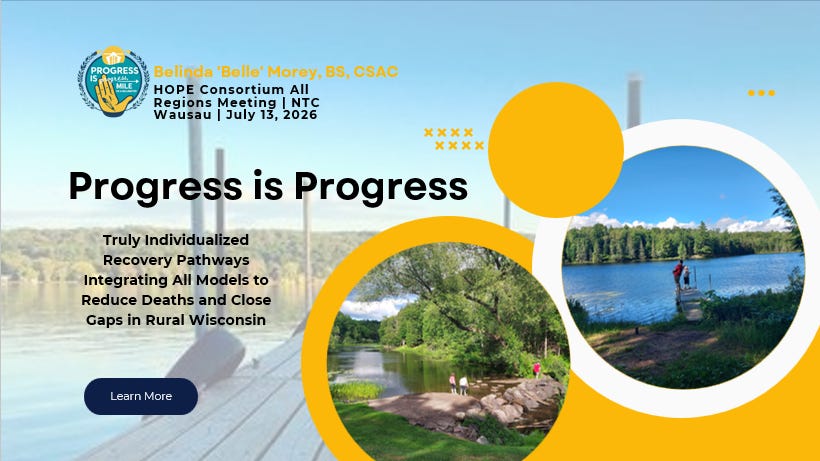
This is the exact presentation I delivered to colleagues across the HOPE Consortium on July 13, 2026. What follows is the full story behind it — the raw truth, the data, the framework, and the invitation to every single person working in rural recovery.
The Room Went Quiet When I Said This
Good morning.
I’m Belle Morey. Clinical Substance Abuse Counselor. Woman in long-term recovery from methamphetamine addiction. Northwoods born and raised.
I stood in front of the HOPE Consortium All Regions Meeting and said something that made the room get real quiet:
“In traditional residential treatment I’ve both gone through and worked in, it was often absolute sobriety or nothing. Highly structured. One primary philosophy. Little room to blend. If you weren’t ready for full abstinence or didn’t connect with the dominant model, you risked being told you weren’t doing recovery right. That rigidity costs lives in rural areas where options are scarce and relapse can mean isolation or death.”
I watched heads nod. I saw the recognition in the eyes of people who have buried too many clients and too many friends.
That moment is why I built this framework. And why I’m putting every single piece of it out into the world right now.
Why This Matters (The Part They Don’t Put in the Manuals)
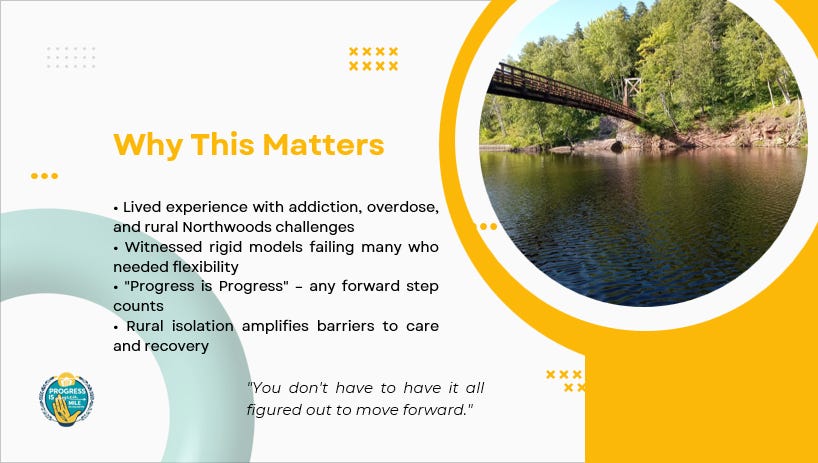
I’ve lived the Northwoods struggle:
Meth addiction
Multiple overdoses
Suicide attempts
Crushing poverty
Domestic abuse
The bone-deep isolation that makes everything heavier
I know the shame when treatment feels like it demands perfection or nothing.
I’ve also sat across from hundreds of clients who don’t fit neatly into one box — people who need tools blended in real time. People who are trying so hard and still get told they’re “not ready” or “not compliant.”
Progress is Progress means any forward millimeter counts.
No shame.
No rigid gatekeeping.
You don’t have to have it all figured out to keep moving forward.
This philosophy isn’t soft. It’s the most evidence-based, life-saving stance we can take in rural Wisconsin.
The Hard Truth About Rural Gaps
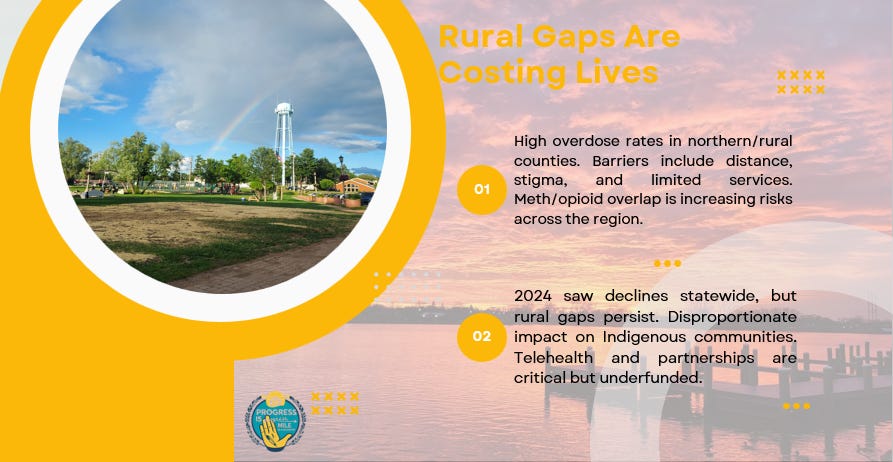
Wisconsin saw encouraging statewide declines in overdose deaths in 2024 — down to 815 according to DHS data. That is real progress and we should celebrate it.
But let’s not lie to ourselves.
In many northern and rural counties within the HOPE service area, rates remain disproportionately high. Meth and opioid overlap is still killing people. Transportation barriers, stigma, limited housing, and access gaps hit hardest — especially in our Indigenous communities.
How many of you know people right now who are homeless and in active addiction?
HOPE’s collaborative model across 16 counties and five tribal nations has laid critical groundwork. I am deeply grateful for that. But rigid, single-modality systems still leave way too many of our people behind.
The 2026 Wisconsin Mental Health and Substance Use Services Gaps Analysis confirms what we already feel in our bones: workforce shortages, waitlists, and rural access remain massive barriers.
The Framework: Truly Individualized Recovery Pathways
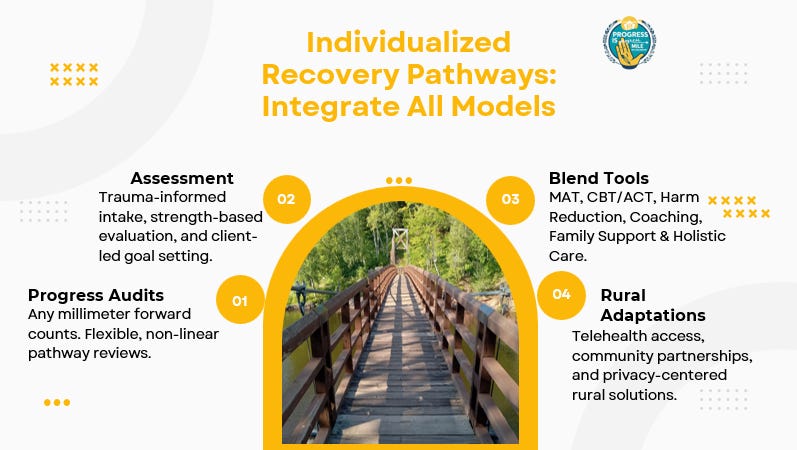
This is the heart of everything.
Four interlocking pieces:
Trauma-Informed, Strength-Based Assessment
Deep listening to readiness, trauma history, cultural context, and rural barriers. Client-led goal setting from day one.Flexibly Blend Tools
Medication-Assisted Treatment (when clinically appropriate)
CBT and ACT for cognitive and acceptance work
Harm reduction to keep people safe and engaged
Recovery coaching for practical momentum
Family systems support
Holistic and culturally grounded approaches
Ongoing Progress Audits
Regular, collaborative check-ins that celebrate any millimeter forward and adjust without shame or judgment.Rural Adaptations
Telehealth that actually bridges distance. Privacy-focused options. Strong community partnerships. Solutions that fit Northwoods life.
This is not “anything goes.” This is ethical, evidence-informed flexibility within scope of practice, drawing from the full toolkit to meet people where they actually are.
“But We’re Already Integrating Models…”
I heard this question coming from a mile away. And I answered it head-on.
Yes. Many of us already integrate. I’ve done it myself.
The difference is who drives the blend and how rigid the container is.
In too many traditional settings, integration still happens inside a primary philosophy: absolute sobriety or nothing. One dominant model. And if you don’t fit, you’re told you’re not doing recovery right.
That rigidity kills people in rural areas.
What I’m talking about is true client-led integration at every level — dynamic, non-linear, program-agnostic. The person, not the program, decides the mix. We celebrate any real movement. We adjust without shame.
ASAM Criteria 4th Edition already calls for individualized, multidimensional, person-centered treatment planning. Recovery-Oriented Systems of Care say the same thing.
This framework simply makes it usable tomorrow morning in a busy rural clinic, a tribal health center, a peer support room, or a telehealth session.
What This Looks Like in Real Life
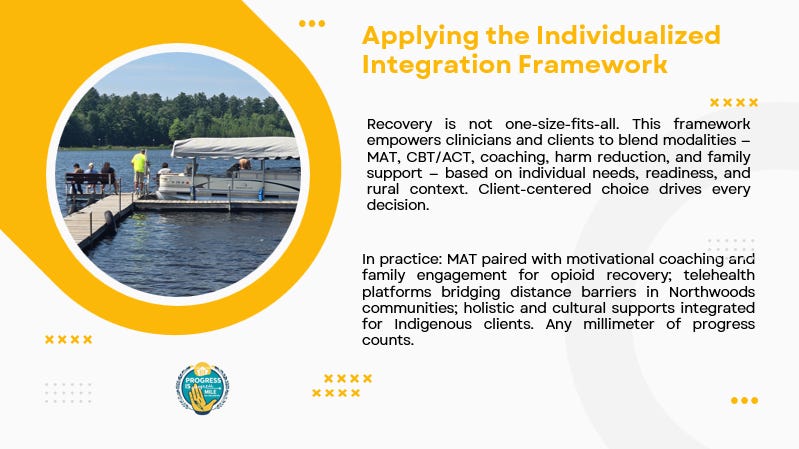
A client on MAT who also gets motivational coaching and family engagement so the whole system around them starts healing.
Telehealth + cultural supports for Indigenous clients in the Northwoods who refuse to drive three hours to a program that doesn’t understand them.
A person who isn’t ready for full abstinence but is ready to use fentanyl test strips, naloxone, and a weekly Progress Audit. We keep them alive long enough for the bigger changes to take root.
Any millimeter of progress counts.
Real Impact (And the Hard Challenges)
What we’re seeing when this approach is used:
Improved treatment retention
Fewer overdose crises
Stronger family reconnections
Expanded rural access through telehealth + coaching
HOPE partnerships actually multiplying their impact
Challenges remain — transportation, connectivity, measurement in rural settings, sustainability of funding. These gaps don’t discourage me. They drive the work.
DHS data, HOPE’s own collaborative model, and national evidence on integrated person-centered care all point the same direction: when we stop demanding perfection and start celebrating real movement, people stay engaged long enough to live.
This Framework Belongs to All of Us
I did not create this to own it.
I created it to give it away.
It is fully replicable across every HOPE region.
It requires no new funding stream to start.
It only requires permission — permission to be flexible, to be human, to treat every millimeter of progress as sacred.
Three things you can do tomorrow:
Add a two-minute Progress Audit to every session.
Explicitly ask the client: “What tools do you want to blend this week?”
Share one rural adaptation that worked for you (telehealth trick, privacy option, peer warm hand-off).
Any millimeter forward, multiplied across Wisconsin, changes absolutely everything.
Let’s Keep Building These Pathways Together
I stand with every single person who has ever felt like the system was too rigid for the person in front of them.
I stand with every clinician burning out under impossible expectations.
I stand with every peer, every tribal provider, every rural nurse, every family member who is still fighting.
Progress is Progress.
Let’s build these truly individualized recovery pathways together.
Any millimeter forward.
Every single day.
Until the gaps close and the deaths stop.
Questions? Reflections? Stories of what this looks like in your setting? Drop them in the comments or email me. I read every single one.
Belinda “Belle” Morey, BS, CSAC
belle.morey@progressisprogressllc.com
ProgressIsProgressLLC.com
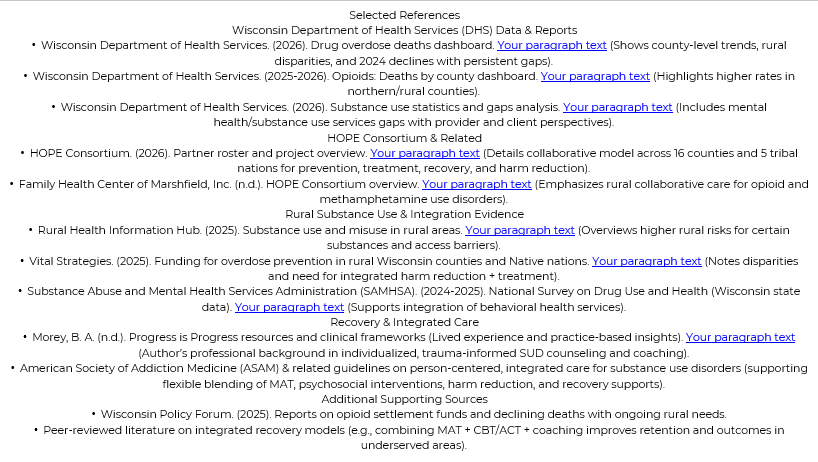
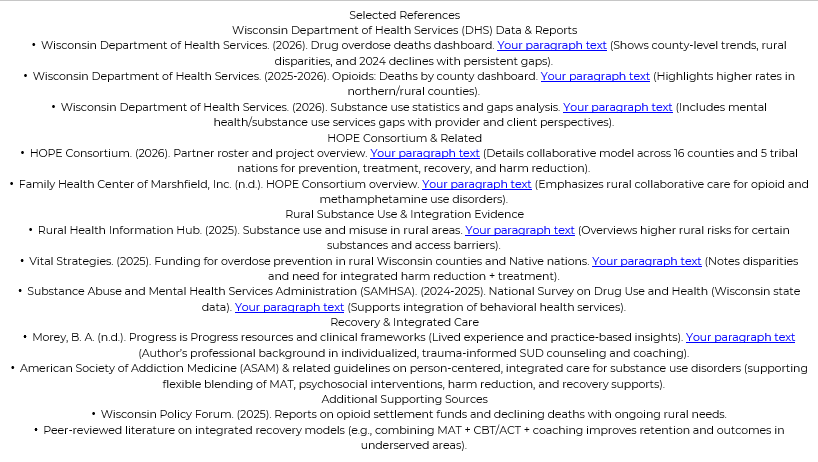
Selected References & Sources
Wisconsin Department of Health Services. (2024–2026). Drug Overdose Deaths Dashboard & Opioid Deaths by County.
Wisconsin Department of Health Services. (2026). Mental Health and Substance Use Services Gaps Analysis (in collaboration with UW Population Health Institute).
HOPE Consortium. (2026). 2026 Project Overview & Mission/Vision documents.
American Society of Addiction Medicine (ASAM). The ASAM Criteria, Fourth Edition — multidimensional assessment and individualized treatment planning.
Rural Health Information Hub & Recovery-Oriented Systems of Care (ROSC) literature on person-centered, integrated approaches in rural settings.
Personal clinical observation and lived experience as a Northwoods CSAC and woman in long-term recovery (anonymized composite examples used throughout).
If this post moved you, share it. Tag a colleague who needs permission to be more flexible. And if you’re a rural provider, tribal partner, peer, or family member who wants to start using these Progress Audits — reach out. We’re building this together.
#ProgressIsProgress #RuralRecovery #HOPEConsortium #IndividualizedCare #NorthwoodsRecovery
Individualized recovery should not mean abandoning standards. It means recognizing that people often reach life-giving change by different roads, at different speeds, with different barriers standing between them and the next faithful step.
A person may need housing before they can stabilize. Another may need medication, peer community, spiritual care, trauma treatment, firm boundaries, or a structured residential setting. The mistake is assuming that one tool must become the definition of recovery itself.
Grace meets people where they are, but it does not leave them there. The challenge is to preserve both truths: every honest movement toward life matters, and recovery must continue calling us toward greater freedom, responsibility, and wholeness.
It still amazes me that some places have not caught on to the idea of Multiple Pathways for Recovery just yet. The science is there, treatment programs are already doing this. Anyone not doing this is really doing a disservice to the people they claim to serve.