

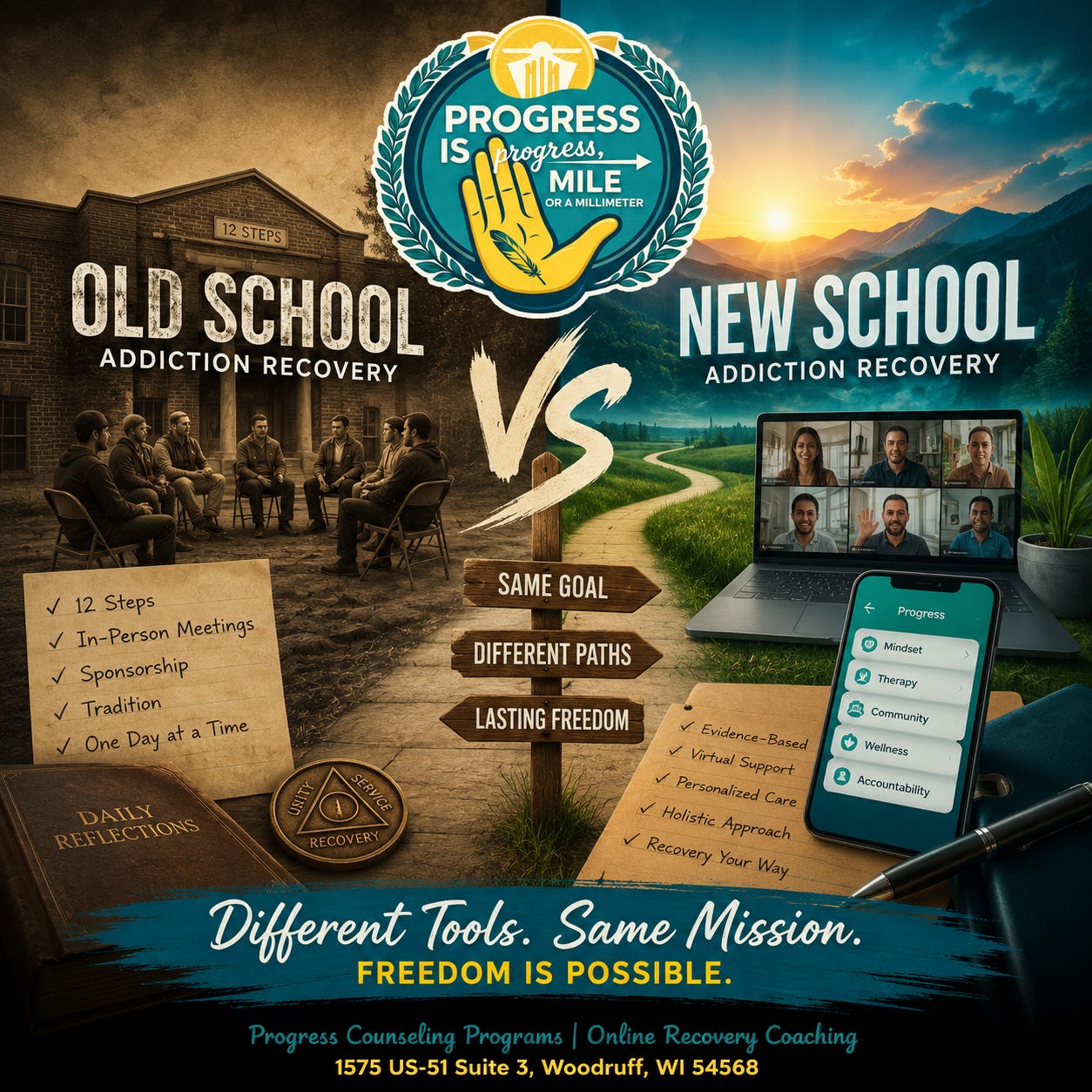
For those of you who have followed my work for a while, you know I don’t sugarcoat recovery. My story isn’t sunshine and butterflies. Meth deals that got me blacked out before worl, overdoses, domestic violence, run-ins with the law, rape, shame so great you feel like you’re dying, it led me here. I became a CSAC and recovery coach because I understand how bad it can get, and sometimes how badly the industry can fail you. Progress isn’t linear, and it sure as hell isn’t pretty. But hear me rant anyway.
I recently did a vlog on old school vs new school recovery. Let’s dig in now, shall we? With studies, blunt talk, and for those of you who know me, no apologetic bullshit. We tell clients, “Use every tool in the toolbox.” Therapy, medication, support groups, lifestyle changes—whatever gets YOU the results you want. How many of us actually practice that? If we say that to clients, why aren’t we doing it for ourselves? Why do we still insist on fighting over models instead of having the actual hard conversations about how to create individualized recovery plans that truly honor client autonomy, while actually holding the people we work with accountable and guiding them toward healthy, long-term recovery?
Old School vs New School Recovery—what even is that?
Old school recovery means the Minnesota Model, basically 12-step programs like AA or NA, the disease concept of addiction, often abstinence-only inpatient rehabs. Surrender to God, moral inventory, peer group fellowship, and lifelong meetings. It originated from the Alcoholics Anonymous movements in the 1930s and became dominant in U.S. treatment after WWII. The benefits include a strong sense of community, accountability, and spirituality, which helped a lot of people connect. We know it works for helping people maintain continuous abstinence, backed by some of the most rigorous research out there.
Walk into a meeting, hit the steps, get a sponsor, stay clean or die. There is beauty in that. It worked for me at 17. It saved many of our lives. But what about when you get sober and you choke on the God talk, the powerlessness stuff, and group dynamics? What if you’re a trauma survivor who gets triggered by the concepts and forced anonymity? What about atheists? Or people on the opposite end of the spiritual spectrum? What about people with co-occurring disorders? Those who NEED medication like buprenorphine to stay alive, and get shamed for it?
The “new school” casts a wider net. It uses what works from many models because the science backs it and puts the client at the center. Cognitive behavioral therapy, motivational interviewing, harm reduction when appropriate, medication-assisted treatment, trauma-informed care, SMART Recovery (secular, skills-based approach), LifeRing, recovery coaching. Addiction is viewed as a disease of the brain affected by genetics, environment, trauma, and learned behaviors—not just moral or spiritual weakness. The focus is on individualized treatment plans built around client autonomy, teaching skills to regulate emotions and behavior instead of just coping, and long-term management of recovery instead of a 28 to 30 day Hallmark holiday.
Try this instead: Use every tool available. Science and spirituality. Medication when necessary. Harm reduction to keep you alive while you’re moving toward changing your use. It’s not disrespectful of 12-step, it’s “and.” Perfect versus progress. Mile or millimeter.
The divide? Us old schoolers can get caught up in, “There is something wrong with you that we can fix through God, a higher power, and the community.” New school tends to focus more on how the substance affected your brain and teaching you skills, finding people you can connect with to help you change your behaviors and environment.
Both have amazing tools that we can use to help clients. I believe the best approach is the integration of both.
Ok, but WHY do we need to shift our thinking? Clients should use every tool, so why aren’t WE?
We love telling clients, “Use every tool in the toolbox!” when they’re stumbling through withdrawals, fresh traumas, and existential crises of trying to maintain recovery while life tries to kick them down. Why do we as therapists, recovery coaches, and program admins say that to clients, but our programs only offer ONE model of recovery because “that’s what we learned” or “that’s what the feds will pay for?” Straight up bullshit.
Studies show that using an integrated approach leads to better client outcomes. From Cochrane Reviews, which are the gold standard for research reviewing other studies: Well delivered twelve-step facilitation is better at promoting continuous abstinence than cognitive behavioral therapy alone, with cost savings. Medication-assisted treatment reduces opioid use and increases retention more than other therapies. Mindfulness works for relapse prevention. Some clients recover without ever stepping foot in a treatment center. What works?
MASTERING INDIVIDUALIZED PLANS: You figure out who the client is—trauma, dual diagnosis, goals, religious, cultural background—and together you PUSH BUTTONS. Some folks need medication for opioids. Some need to heal from trauma. Some need peer support, whether 12-step or secular, some need to work on relationships, including with family. Build healthy lifestyle habits. Check in on your progress. No shame if there is a relapse. Relapse doesn’t make you a failure, it’s data.
Who’s driving the bus? Letting clients guide recovery without dictating it.
This is the big one. Are you driving the session or is the client? No and yes. You.
Client autonomy is important. We shouldn’t impose our values, beliefs, or trauma-based reactions, also known as triggers, onto clients. “Well, this worked for me so I know it will work for you!” is not recovery, that’s manipulation, plain and simple. However, true client-led everything can be irresponsible too. Addiction impairs your ability to make sound decisions sometimes. Just because you can doesn’t always mean you should.
So how do we walk the line? Relationship autonomy. We make decisions in relationship and within our own culture or context. Use motivational interviewing to draw out their own reasons for change. Collaborate on goals. Offer options and information without judgment. Your job is to sit with discomfort, provide information, call her out gently when denial or sabotage behavior emerges, and support their decision while it’s their decision—as long as they are informed.
CHECK YOUR BIASES: Get regular supervision. Go to therapy. Journal about what triggers you about your own recovery story. Ask yourself: Am I pushing this service because I’m afraid they’ll relapse or rock the boat if they don’t? Does this client’s recovery threaten the model I subscribe to? Am I triggered by their non-compliance with me? The more you know yourself—trauma stuff, triggers, also known as countertransference, cultural blindspots—the better you’ll be at leaving your stuff at the door. Remember, progress is progress means ALLOWING clients to celebrate their victories, not your agenda.
Federal Funding doesn’t require 12-step, THE MYTH ABOUT GATEKEEPING SERVICES
Here’s the big scandal I dug into: Do rehab centers have to operate 12-step based to accept federal or state funds? Short answer, No. No they don’t!
SAMHSA and state block grants require evidence-based practices like medication-assisted treatment, and have to provide an alternative to religious-based or 12-step mandated programming if that is the client’s desire, according to Federal Charitable Choice rules. U.S. Department of Justice grants cannot force anyone to participate in 12-step or other groups, and MUST provide secular alternatives. The newer Comprehensive Opioid Recovery Centers grant specifically pushes individualized, holistic recovery with medication-assisted treatment as one of their big areas for funding.
So, they literally can’t tell you that you HAVE to do 12-step to get federal money. But?
Long answer: A lot of the legacy programs are, and have been, 12-step only or very abstinence focused. Legacy means they’ve been around since the blow-dryer hair models of treatment, usually run by nonprofits started decades ago. Funds, licensing, staffing, facility costs, and culture create a weird status quo. Not every grant funder or state regulator out there mandates it, but it’s hard to find recovery centers that DON’T use the old model, especially in rural communities or “traditional” inpatient settings. So clients get kicked out if they don’t “surrender?” Therapists get fired for suggesting medication? Families are shamed into 12-step only “or else.” Information about services, let alone material help, can be scarce.
So what? Advocacy! Push for lawmakers to link funds more strictly to outcomes, and true individualized, evidence-based care, including access to medication-assisted treatment, trauma-informed care, multiple types of peer mutual-help meetings, and options. When you can, educate funders, state administrators, and regulators on the science. Support practitioners who offer hybrid models.
How do we help clients who NEED to advocate for themselves because no one else will, and build real individualized plans?
Know your rights if you are a client shopping for services. Ask for what you need. Ask questions. Tell them YOU want to be in therapy, you WANT to know about all your options. Document what they are and aren’t telling you. Go to your next meeting with your provider, probation officer, or insurance company with resources or articles printed out. Ask to meet with someone who CAN give you what you need. Recovery peer advocacy groups, recovery community organizations. USE your voice.
Educate other providers. Refer out when you can’t offer the whole toolbox. Have fellowships on site that AREN’T 12-step if you operate in that world. Have SMART meetings or other secular options. Train therapists in various modalities. Have medication-assisted treatment prescribers on staff. For God’s sake, track outcomes that matter to the client—reduced harm, quality of life, sustained recovery—not just “did they get clean time?”
Individualized treatment should ALWAYS start with a comprehensive assessment of the whole person. Build them a menu of options, including therapy modalities, medication options, peer supports, vocational services, and family work. Meet with them regularly to review, adjust, and celebrate successes with them AS THE DRIVER. Teach clients about how addiction robs them of their autonomy, because that connection often gets disrupted. Help them rebuild it by celebrating small choices and successes.
It works. People actually stay. Drop-off from the shame buses decreases. Relapse is just more information. Families learn how to support instead of trying to control. Communities become stronger and healthier.
Why does any of this matter? Clients deserve every tool available that works. We owe them the same honesty we tell them to have with themselves.
Be kind to each other, check your stuff, and if you have to stand on your soapbox, do it for the right reasons. Guide with compassion and science. Advocate your ass off for funding that rewards programs who actually help diverse populations of people. Stay open-minded. There is no one way to recover.
Progress is progress, mile or millimeter. If you’re a burned out counselor fighting rigidity, a client who felt betrayed by your program or treatment facilities, or just fighting to breathe one more day, the toolbox needs to stay open. Every tool. Every single thing that actually works for that person. No shame, no leaving folks behind because your model didn’t work for them.
Let’s build that world together. What’s one step you’ll take today to change?
P.S. Subscribe, drop your story below, or hit me up if you need some real-talk support. Been there. Done that. We’ve got this.