

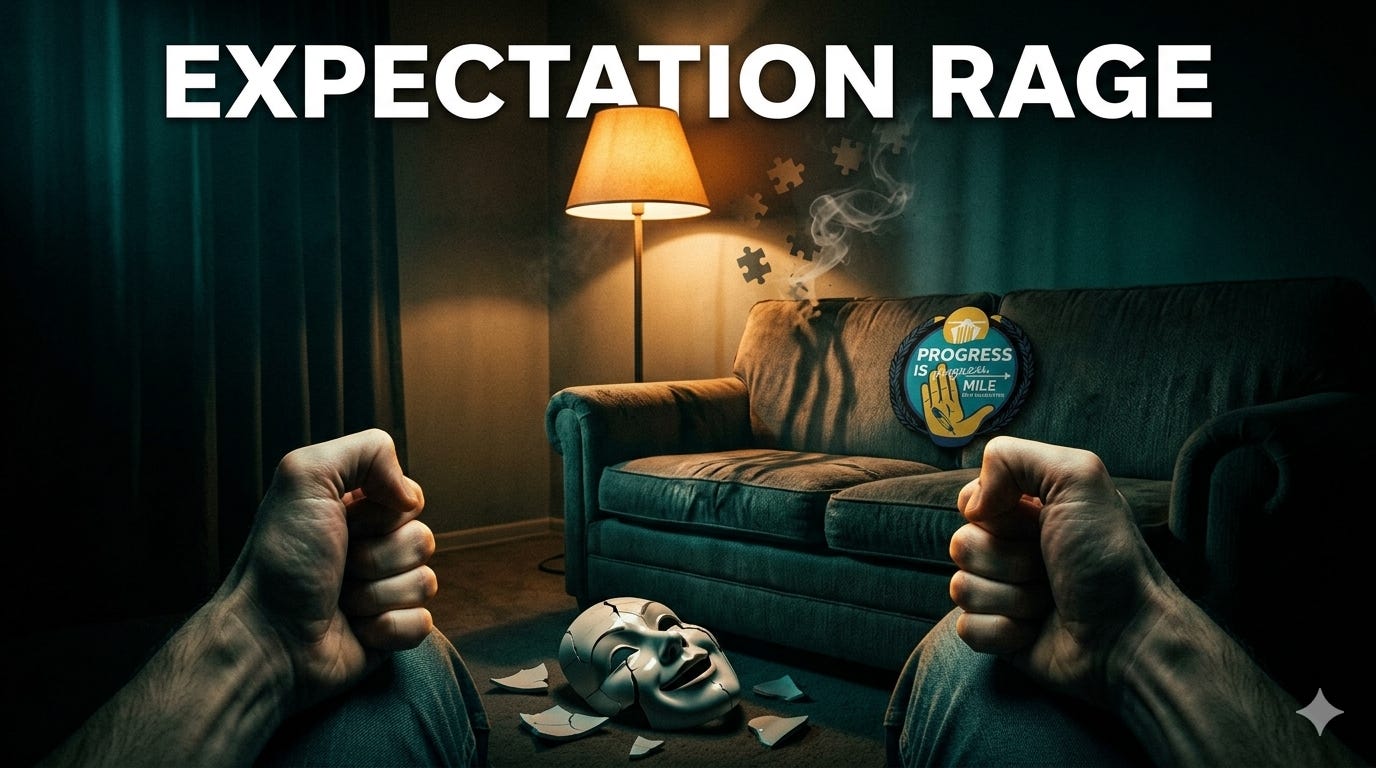
Close your eyes.
Picture the scene like the opening shot of a raw, unflinching film.
Evening. Lights low. One lamp throwing long, jagged shadows across the room. You’re sitting on the couch opposite me, and you are not calm. Eyes sharp and burning. Fists curled so tight your knuckles are bone-white. Jaw locked, teeth grinding against that dull, decades-old ache of humiliation. Your voice comes out gritty, cracked, like it’s been trapped too long:
“I’m so fucking angry at the world right now. I’m not living the life I should be living… and I hate myself for it.”
That’s Expectation Rage.
It doesn’t always kick the door in with fireworks. Sometimes it’s a whisper that’s been building for years—decades, even. You were told “be good,” “fit in,” “make us proud.” You performed. You smiled. You numbed. You shaped yourself into someone else’s idea of “good enough.” And then one day you wake up at 3 a.m., chest heaving, gasping for air, staring at a stranger in the mirror.
I sat with that exact energy today. It cracked me open too—because holy shit, I know that feeling in my bones. We ALL know it. Whether addiction stole your years, mental illness rewired your brain, or life just kept throwing curveballs you never asked for. Nobody handed us a manual titled “How to Be Yourself When the World Demands You Be Someone Else.”
So we drank. We isolated. We masked. We let other people’s expectations carve us into shapes that never quite fit.
Especially if you’re neurodivergent.
Too loud. Too weird. Too awkward. Not enough this, too much that. Those words stick like tar. And when mental illness or addiction crash the party on top of it? The inside voice gets vicious:
“Not good enough at recovery? Must be lazy. Or just a shitty addict who can’t stay sober.”
“Can’t socialize without drinking? Clearly something’s broken—better go get your brain chemistry fixed.”
It’s so damn easy to turn the rage inward and blame ourselves. I do it on the days when my autism won’t let me sit alone with my thoughts without spiraling.
But here’s the question that stops me cold every time:
When the hell did we stop giving ourselves permission to find out who the hell we actually are underneath all that conditioning?
When loneliness starts ripping your soul apart and you push everyone away anyway—that’s not rock bottom.
That’s the exact moment you’re supposed to start.
Isolation.
Oh, sweet hell, I know isolation like an old lover who won’t leave.
At first it feels like relief. No one asking you to explain yourself. No forced small talk that feels like chewing glass. No eye contact that physically hurts. For neurodivergent brains, “normal” connection is a motherf*cking workout—masking so hard you lose pieces of yourself you didn’t even know you had.
So when the masking finally gets too exhausting, you hit the wall and think, “F*ck it. I’m hiding.”
The scene plays out like this:
Saturday night. Phone face-down on the table. The silence in your apartment is so thick you can hear your own heartbeat. You scroll past friends’ stories—laughing, living, connecting—and feel that familiar stab of “they don’t miss me anyway.” Reaching out feels like stepping off a cliff with a parachute made of old expectations and bad ideas. So you don’t. The rage simmers. The shame whispers. And the walls close in, one quiet hour at a time.
That’s the dangerous part. Isolation isn’t peaceful. It’s a slow suffocation that convinces you you’re safer alone than seen.
But here’s where the movie pivots—no perfect hero montage, just gritty truth.
Research from SAMHSA and multiple studies on peer recovery support shows something powerful: when you stop doing this alone and connect with people who actually get the muck—lived experience, not just clinical advice—things shift. Treatment retention goes up. Relapse rates drop. Isolation loses its grip. Real connection starts to feel possible again. Because someone who’s been waist-deep in the same quicksand knows exactly how to throw you a rope that actually holds.
Shit, buddy… we ALL deserve to find ourselves.
Screw how long you’ve been sober or clean. If you’re neurodivergent and feel like an alien in your own life, you deserve this just as much as anyone else.
Comparison is a thief. Shame is a liar. But giving yourself even one judgment-free minute? That’s revolutionary.
So what does that look like in real life?
Turning down the thing your loved ones want—even if it disappoints them—because you finally know it’ll drain the last drop of your soul.
Letting the anger rise instead of shoving it down or punishing yourself for feeling it.
Hitting send on that awkward “hey, I’m lonely and could really use some company” text (seriously—send the damn text).
Existing for five whole minutes without the old programming running the show in your head.
If you’re neurodivergent, I especially want to hear from you: How has isolation or masking shown up in your recovery or mental health journey? When did you first realize you were living someone else’s script?
Drop it in the comments. Say “me too.” Tell your raw, messy truth. Share this post with someone who’s quietly unraveling behind a perfect smile. None of us are the same snowflake. Your brain, your wiring, your story—that’s not broken. That’s you.
You’re complex. We all are.
And this space? Zero judgment. Zero stigma. Just real humans showing up exactly as they are.
Progress is progress—even when it’s angry, messy, rage-filled, tear-soaked progress.
Share your story below, or just say hello. Let’s break the silence together.