

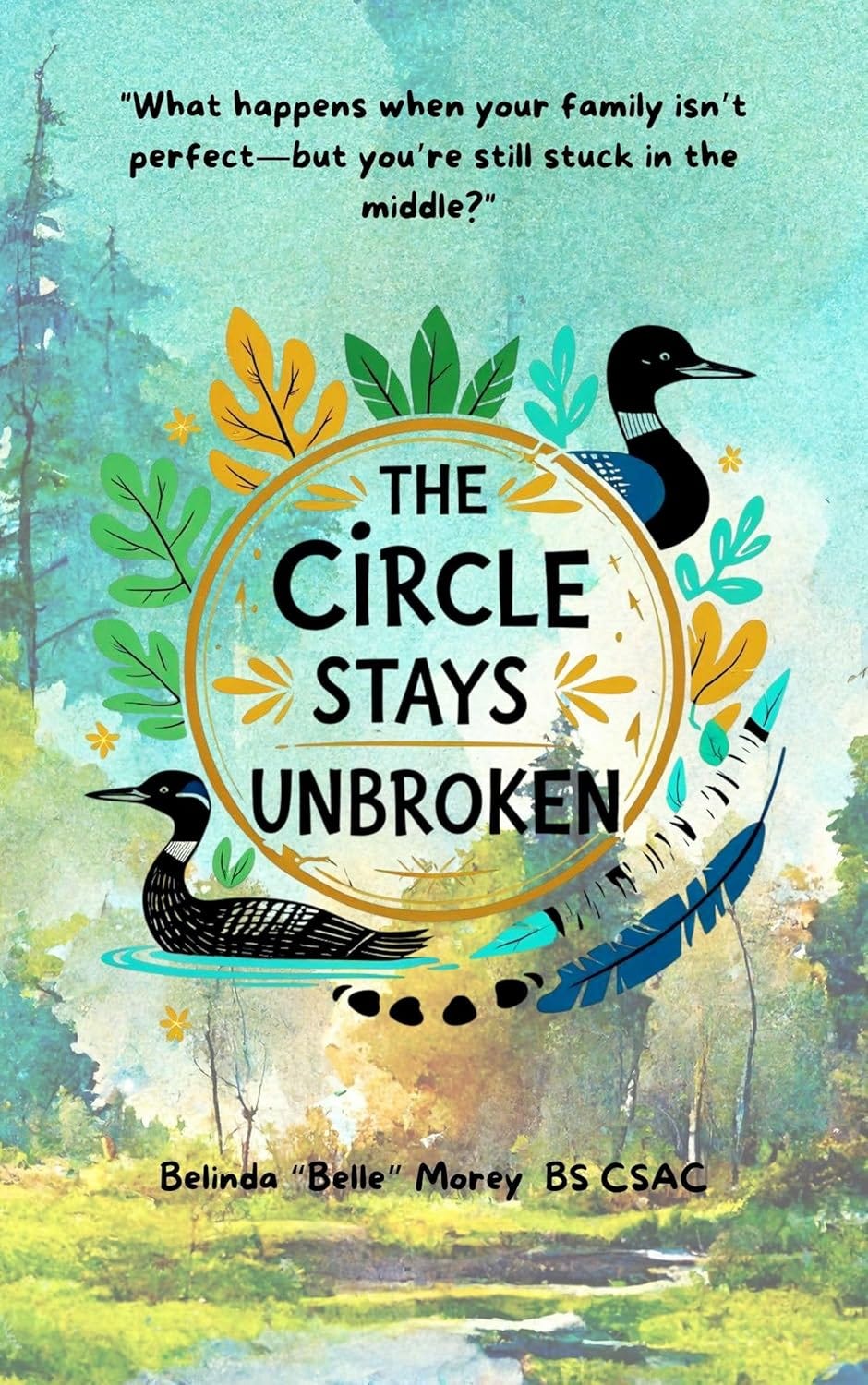
Just released: “The Circle Stays Unbroken,” a story that’s already resonating with families, educators, and clinicians across the country.
Set in Wisconsin’s Northwoods, this children’s novel follows Eli and his brother Sammy as they navigate the return of their father from prison—a homecoming marked by hope, disappointment, and the tough reality of addiction’s impact on families. Through their Ojibwe stepfather’s stories, they discover that circles—like families—can stretch, bend, break, and still, miraculously, hold.
This book isn’t just for kids. It’s for adults who love them, for anyone whose life has been touched by addiction or family struggle, and for professionals looking for ways to spark tough but necessary conversations. Written with honesty, compassion, and the wisdom of lived experience, “The Circle Stays Unbroken” is a testament to resilience—reminding us that healing is never linear, but always possible.
If you work with children, families, or in mental health, I hope you’ll check it out, share it with your clients, or add it to your recommended reading lists. The conversation about addiction and recovery can’t start early enough—or include too many voices.
Available now on Amazon: https://a.co/d/7GY8Cn2
Let’s keep the circle whole.
Special Sneak Peek Below
Prologue: Kitchen Shadows
A haunting memory lingers in the kitchen air—a time when the house was filled with noise, smoke, and a sweetness that masked something bitter. This is the backdrop of a childhood shaped by absence and chaos.
Sometimes, when I walk into the kitchen at night, I still catch a whiff of something sweet and burnt, like marshmallows toasted too long over a campfire. It isn’t the same as when we make s’mores—this smell is sticky, sharp, mixed up with the haze of old smoke that used to hang in the air. Back then, the house was always loud. The TV would be turned up high, Dad’s voice booming as he played video games for hours, controller clicking and clacking fast as his fingers. Mom would be at the table, hunched over something—taking apart pens, twisting little bits of metal together, her hands moving quick and jittery.
Sometimes, everything felt fuzzy, like the air was thick enough to chew. The lights seemed too bright, the colors too sharp. I’d run in circles with Sammy, trying to get Mom or Dad to look at us, but their eyes were always on something else. Dad barely looked away from the game, even when I climbed onto his lap. I remember once he handed me a controller that wasn’t plugged in and told me I was “helping him win.” I wanted to believe it.
The kitchen always smelled like burnt sugar and something bitter. Mom used to suck on those candy root beer barrels, the hard kind that stuck in your teeth. She’d give one to me and Sammy, slipping it into our hands with a quick smile. “Here you go, sweet pea,” she’d say, her lips shiny and brown from the candy. I sucked on mine as long as I could, the taste sweet and strange, like a treat and a secret at the same time.
I remember the sound of Dad’s lighter, the tiny flick and whoosh, over and over. Sometimes smoke would curl up around Mom’s head, making her look like she had a cloudy halo. Once, I asked her if we could make real marshmallows, the kind you roast on a stick. She laughed, but it was a weird, scratchy laugh that made my stomach twist.
There were nights when everything felt stretched out, like bedtime never came. Sammy would curl up under the table with his blanket, humming to himself. I’d wander around, picking crumbs out of the carpet, licking the last of the root beer barrel until my tongue hurt. Sometimes I’d fall asleep on the couch, the TV flashing colors onto my eyelids, Dad’s video game noises mixing with Mom’s voice, soft and far away.
Now, when I think back, it’s all jumbled up—a blur of lights and sounds and smells. I didn’t know what any of it meant back then. I just knew the house felt different sometimes, like all the grownups were somewhere else, even when they were right in front of me.
Chapter 1: Phone Calls from Far Away
Distance stretches wide between voices on the line—the echo of a father’s absence, and a boy’s struggle to fill the silence with something real.
The first time Dad called from prison, I thought I’d have a million things to say. But when the phone rang, I just stared at it, my palms sweaty, my heart thumping behind my ribs. Mom stood in the kitchen doorway, her eyes soft but tired. She held the phone out to me, but didn’t make me take it. For a second, I almost wished she’d answer for me.
I pressed the phone to my ear, the cord tugging against the counter, and waited for his voice to cut through all the crackle and static. It sounded far away, like he was underwater or calling from some different world.
“Hi, Dad,” I said, the word catching in my throat. It still felt strange, calling someone ‘Dad’ who hadn’t been there for birthdays or pancakes on Saturdays. I traced my thumb over a scratch on the phone’s plastic, searching for something to say.
“Hey, Eli. How’s things?” he asked. There was a long pause, the kind where you can almost hear him breathing.
I tried to tell him about school, about Baby Dog chasing the cats and sliding into the table legs, about how Sammy had drawn a loon so real it might fly off the page if you looked away for a second. I waited for Dad to laugh, or ask for details, but he just said, “Uh-huh. That’s good, bud.” His voice wobbled, like he was trying not to let something slip out.
Sammy stood in the hallway, rolling a pencil between his fingers. Mom nudged him forward, but he shook his head, eyes on the floor. Sometimes he’d wave at the phone, then disappear into his room, the door clicking shut behind him. I could hear his pencils moving across paper—scratch, scratch, scratch—telling stories he didn’t have words for.
I always felt this pressure to say something big, something that would fill up the space between us. But when the time came, all I could do was curl the phone cord around my finger and listen to the silence. I wanted to tell him I missed him, but the words stuck. Every time.
The calls never lasted long. Sometimes Dad would ask about the weather, or if we’d been fishing lately. Sometimes he’d go quiet and just listen to me breathe. Once, I told him about the way the birds woke us up in the morning with their wild calls. He was silent for so long, I thought maybe the line had gone dead.
When the call ended, I put the phone down and drifted to the window. The lake stretched out, calm and endless, sunlight flickering on the water. I pressed my forehead to the glass and tried to picture where Dad was—if he could see the sky, if he remembered the sound of ducks calling across the water. I wished I could skip a stone all the way to wherever he was.
Mom came over and wrapped her arms around me. Her sweater smelled like woodsmoke and coffee. She didn’t say anything right away, just sat with me until my shoulders relaxed.
“Feelings are like the weather,” she finally said, her voice gentle. “Sometimes cloudy, sometimes clear, but never wrong.”
Most days, Sammy didn’t want to talk about the calls. He’d just go back to his drawings, hunched over the kitchen table, Baby Dog curled up at his feet. Sometimes I’d find a picture tucked under my pillow at night—a loon gliding across black water, a circle with cracks growing wildflowers out of the broken lines. Sammy didn’t say much, but his drawings always knew what I was feeling, even when I didn’t.
After a while, the calls became a strange kind of routine—awkward, short, and always leaving me with a lump in my throat. Sometimes I wondered if Sammy felt it too, but he never let on. He just watched the loons outside, or let his pencils do the talking.
If you looked at our family from the outside, you might think we were just like everybody else. But if you listened close, you could hear the spaces where things were missing, and the quiet places where we tried to fill them in.

feels real ~ makes me a bit uncomfortable as i had a "Dysfunctional' home life as well ~ i started taking responsibility for my life at 14 ~ 🙏📿
Congratulations! 🌼 This is wonderful. 💛