
A Relapse Does Not Erase Your Progress: Why ‘Starting Over’ Is Bullshit

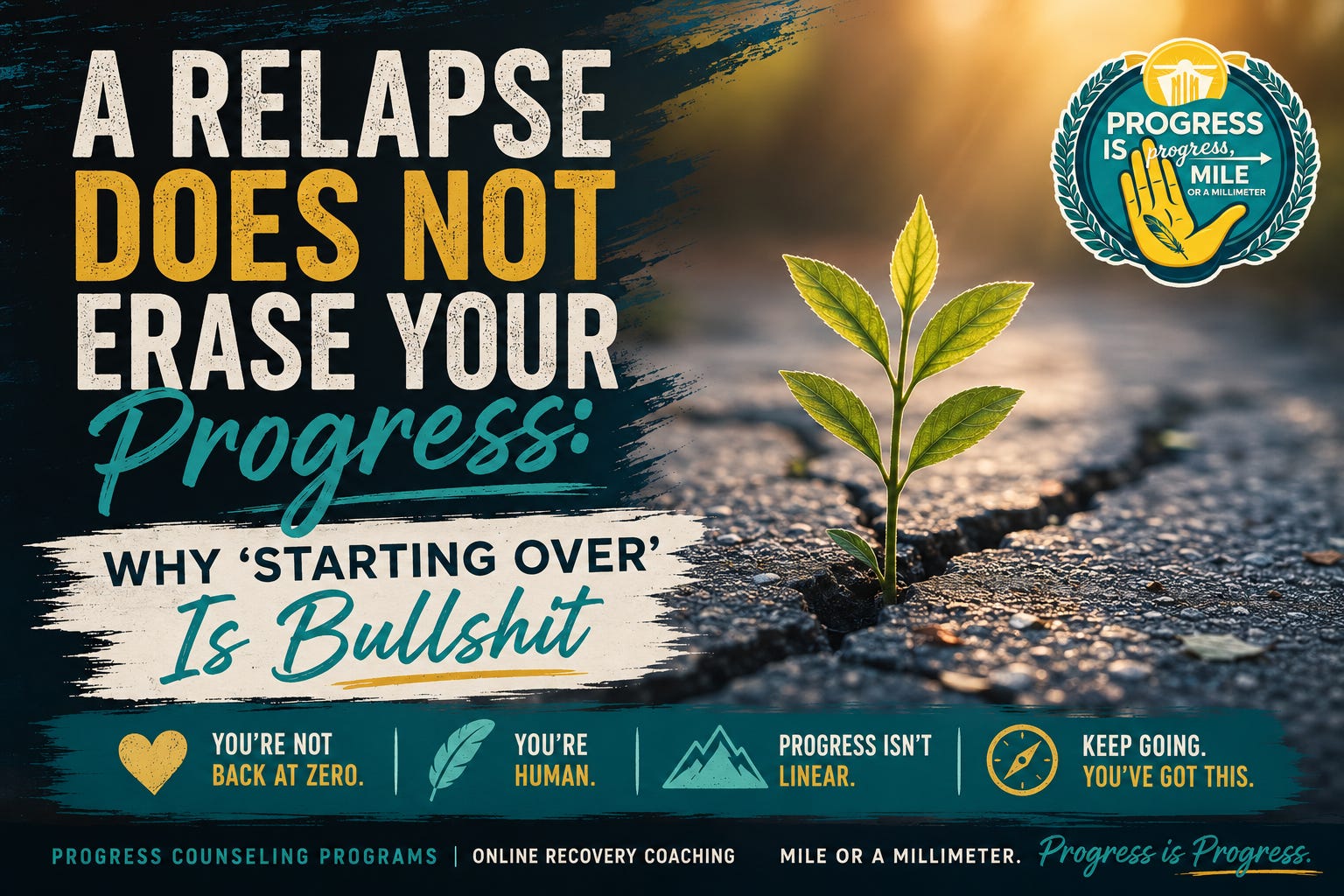
My Slip Did Not Make Me Fail: You Have NOT Failed Recovery
I can still feel it in my chest—the moment when it happened. The momentary shock, like someone literally sucked the air out of the room. The stabbing pain that followed. The crippling anxiety that sent electricity through my hands and squeezed my stomach into tight knots of pure fear. Heavy numbness layered on top of all of it, leaving me staring at the wall and wondering how the hell I found my way back here.
It didn’t happen all at once. There wasn’t one dramatic moment that pushed me over the edge. Just a handful of small choices that felt reasonable at the time. “Just this once.” “I deserve it.” “I got this.” Until they piled up and I couldn’t see the ground beneath my feet anymore.
My last relapse wasn’t even chemical. It was behavioral—criminal, actually. But whether it’s substances, behavioral addiction, or what many of us now call a reoccurrence of use, the feeling when you take that step back is the same.
Shame volume turned way up. That nasty master voice in your head screaming YOU’RE RUINED turned way up. And the recovery community often makes it worse by treating that moment like it erased every hard-won victory that came before it.
“Day one all over again.” “You have to start from scratch.” As if the coping skills you developed, the habits you changed, the different way you started showing up for your kids or your partner just vanished overnight.
Guess what? They didn’t.
Saying your recovery starts over with a slip or reoccurrence is bullshit. And it harms us.
Repeat after me: A relapse does not undo your progress.
A moment of weakness gives you information—hard data about what’s still injured in your nervous system, what parts of your life need more attention, and where the old habits of numbing or chaos are trying to reassert control. Telling yourself you have to start from square one keeps people trapped in shame instead of learning.
What Are We Actually Afraid Of?
For some people a slip means a full return to use. For others it’s one night of old habits, an anonymous binge, crossing a boundary you promised yourself you were past, or making a choice that goes against everything you said you stood for. The common thread is what happens next: the sinking belief that you failed at recovery. That you’re no better than you were before. That all the work was some elaborate lie.
Imagine you’re hiking deep in the Northwoods. You’ve tromped for miles over rocky terrain. You’ve learned which roots to sidestep, which hills drain your energy, and which clearings give you rest. Then one day you get off the trail—maybe you took a wrong turn, maybe you slipped on a muddy patch. Does that mean all the miles you already logged vanish? Does the trail knowledge disappear from your brain? Of course not. You just have to re-center and keep moving forward with new information.
Shame loves to tell you the whole map is ruined. It’s lying.
Doing the Real Recovery Work
Treating every slip as a fresh start does us (and our loved ones) a disservice for three clear reasons:
It negates the brain work you’ve already done. You changed physical wiring when you got sober. That capacity didn’t disappear because you made some hard choices—it just went unused for a stretch.
It feeds the shame spiral that drives too many people into isolation or deeper use.
It teaches everyone that recovery is all-or-nothing, when the real skill is learning how to recover from the setbacks.
Progress is messy sometimes. Relapses and reoccurrences are part of the data set. They don’t get to press the erase button on your whole journey.
What My Slip Taught Me
Once I could finally look past the shame, that hard season showed me some important truths:
My tolerance for boredom, success, and stress still needed nurturing. I had jumped back into over-functioning and stopped feeding my nervous system.
Balance is maintenance, not a destination. The choices didn’t come out of nowhere—months of ignoring my own needs led me there.
Isolation was still my default when life got hard, even though I knew better.
Not everyone who claimed to support my sobriety was actually loyal to the real me. The people who stayed when things got messy were the ones who mattered.
Most importantly: I didn’t have to reinvent recovery from scratch. I had years of practice under my belt. Years of learning how to get back up. All I had to do was assess what wasn’t working and adjust the plan—not throw the whole damn thing out.
Getting Back Up Is a Skill — Make These Tools Yours
“Starting over” is not a helpful framework. Instead, experiment with responses that actually fit your life and nervous system. These are starting points—adapt them, discard what doesn’t land, and make them yours.
The 48-Hour Honesty Window
Somewhere between the moment it happens and 48 hours later, tell one trustworthy person the real version. Shame loves secrecy. Honesty starts the repair.Data, Not Drama Exercise
Three simple columns:What was happening in the week or two leading up to it?
What did I need that I avoided or didn’t ask for?
What’s one small change I can make to get that support this week?
No self-flagellation required. Just useful information.
Recover Progress, Not Perfection
Count the days both ways—consecutive days and total days of effort since you started this journey. Both numbers matter. Your recovery history is longer than your current streak.Repair Without the Performance
If the slip affected people you love: “I messed up. I’m sorry. Here’s what I’m doing about it. I’m still here.” Clean. Direct. No disappearing act.Update Your Safety Plan
Treat the experience as data. What early signs did you ignore? What rest, connection, or boundary did you need more of? Adjust the plan so it actually works for you.
These are suggestions, not rules. The only recovery tools that work are the ones you’ll actually use.
Don’t Call It Starting Over
You didn’t suddenly forget how to be sober or lose the person you worked so hard to become. You’re almost always farther along than the shame wants you to believe.
A slip is a step back—not the end of the journey.
How did this land for you? Have you ever carried shame about a slip or reoccurrence that you’re ready to reframe? Share as much or as little as you want in the comments. This is a space for the real talk.
If you’re in the middle of the aftermath and want support that doesn’t treat you like a disappointment, head to ProgressIsProgressLLC.com and book an intro call. First one’s on me. Don’t give up on you.
— Belle
Great insight, thanks for making it clear that relapse isn't something to lose traction over. I really struggled with relapse and the stigma around it. Love the resources available today.
I love that you brought this to our attention. The painful and shameful stigma attached to a relapse needs to be broken. Thank you for blazing another path for people struggling with this perspective.The belief of having to start from square one, sucks! It keeps people stuck in a vicious cycle and kills people. Keep up the great work!!!! Miigwech!!!