
A Deep Dive Into NF’s “How Could You Leave Us”—Grief, Addiction, and the Kids Who Are Left Behind

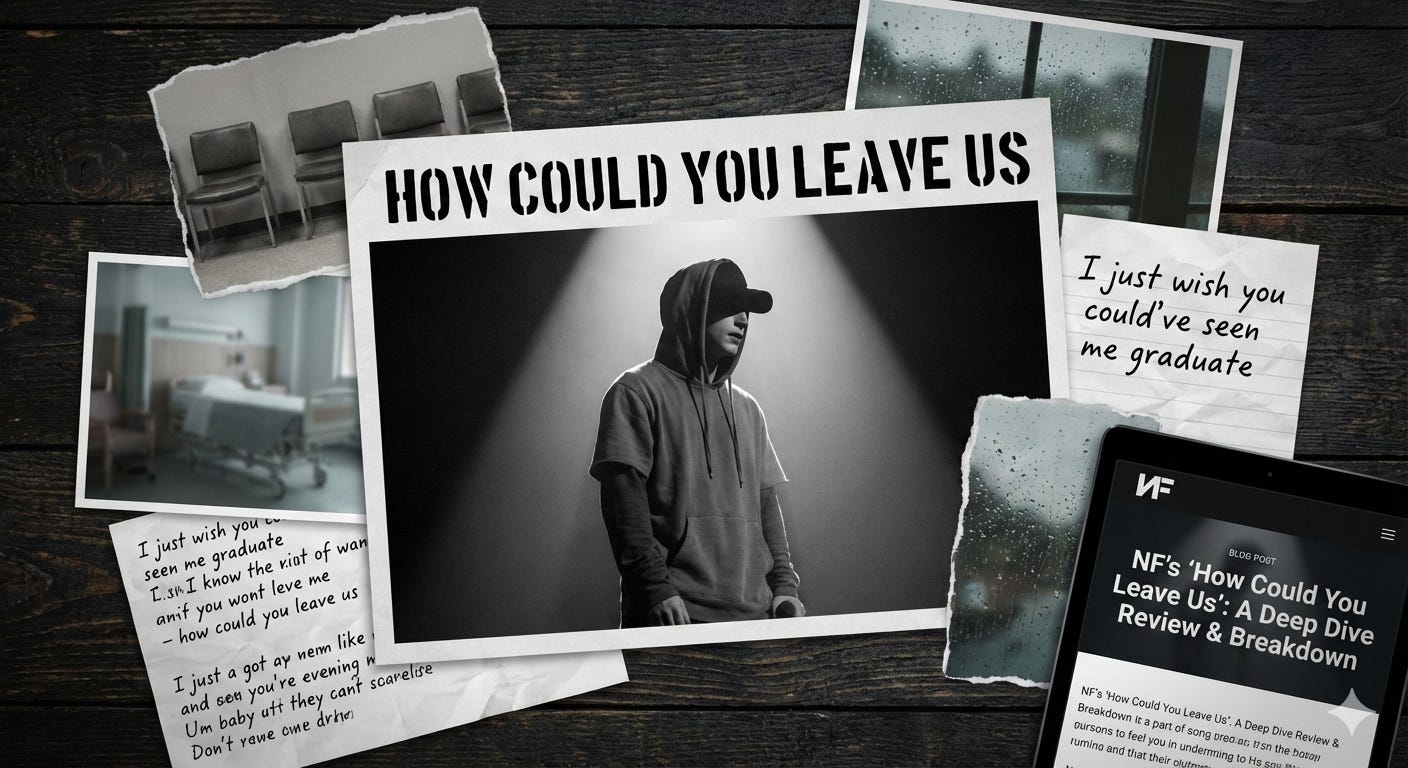
How Could You Leave Us: NF, Addiction, and the Brutal Mess of Surviving
I’ve lost count of the funerals. I’ve lost count of the mornings I woke up wishing my phone would stop buzzing—maybe this was the time I’d find out it was over, for good. Or maybe, again, I’d just find out it was more of the same: another headline, another “Are they okay?” Another round of pretending this is normal.
NF’s “How Could You Leave Us” isn’t just a song. It’s a punch in the gut. It’s all of us stuck at a window, watching for someone who’s never coming home the way we want them to. And if you’ve ever loved an addict—if you’ve ever been one—you know exactly what that waiting feels like. Heavy. Rotting. Like grief, but worse: the person is alive and walking around, but the part that knows your birthday, the part that remembers to pick you up from school, the part that gives a shit—that part is long gone.
Maybe this is where I’m supposed to say, “It gets better,” or that music is healing, or whatever. Sure. Some days. But sometimes you just gotta walk straight through the swamp and let the mud get all over you. This song? It’s mud. It’s the swamp air. It’s me, and my kids, and my mother, and my father. It’s all of us, orbiting around some black hole of addiction, just hoping any of us make it out.
“How Could You Leave Us so Unexpected?”
NF starts the song damn near whispering, and that’s how grief sneaks up on you—quiet, unexpected, a flicker you keep trying to ignore. I hear that line, and I’m not NF, but I am the kid at the window. I’ve been the child waiting for my mom to show up clean, for my dad to pour something other than whiskey for breakfast. I’ve been the addict myself—staring at my own reflection, wondering when I became the one other people needed to save.
Let’s not kid ourselves: this track isn’t just sad. It’s furious. “I needed you, I needed you.” Say it enough and it starts to sound like a prayer, or a threat, or maybe both. That’s what addiction does—to kids, to parents, to everyone in the blast radius. You stop believing “need” is even a real thing. You just keep asking, anyway. NF’s pain is my pain is your pain is the pain we’ve all inherited, handed down like a family heirloom nobody wants but nobody knows how to bury.
Loving Someone Who’s Gone, but Not Dead
Nobody talks about what it’s like to lose someone inch by inch, day after day. You get a parent—or a partner, or a kid—who gets swallowed up by this thing, this prison that isn’t jail but might as well be. People think grief is about funerals, about flowers and casseroles and “time heals all wounds.” No one explains how much it hurts to see someone still breathing, but so far away you can’t touch them.
I spent years with my own mother fading out, in and out of the life of her children. Meth. Booze. Pills. Whatever. She was the queen of self-destruction, but also the queen of making you believe every time she collapsed that this was it—this was the bottom. My father? Mastered his own dance with alcoholism. And me? I became the person waiting, then the person using, then the person trying to figure out how the hell to mother my kids without passing them the same torch of misery.
And still, you yearn. That’s the word nobody uses—but it’s the only one that fits. You yearn for a parent, a lover, a son, a self, to just show up already. I listen to NF’s voice crack in the song and it’s not performance. It’s the sound a soul makes when it gets tired of waiting.
Anger and Shame: The Double-Edged Sword
People like to talk about the anger of addiction, but not the shame. Or maybe the shame, but not the comfort. Let’s be real: nobody ever admits how comfortable that feeling is. Hating it, loving it, needing it. The ritual of getting high, or blacking out, became my oxygen for a while. You don’t want to love the thing that’s eating you. You just do. That’s what’s so sick about it, so disorienting—it’s a lover and a killer in one.
NF says, “I don’t know if you really tried to kill yourself or just a cry for help.” I’ve yelled that kind of thing at plenty of ghosts. I’ve screamed at news alerts, tasted bile every time the phone rang. Because if you’ve watched addiction take someone you care about, you know that fury. You know how it festers. You know what it feels like to hope, and then hate yourself for hoping.
And then there’s shame. Fuck shame. Seriously. If shame alone could get a person clean, my family would be the model of health and wellness. Shame never kept me sober. If anything, it just made me chase the numb faster. There’s an essay on my Substack—“I’m an Addict and I’m Not Sorry”—where I say fuck it, right in the ear to shame. That’s the only way you get honest enough to heal: you torch shame, and you bring what’s left into the light, even if your hands are shaking.
Music: Trigger and Salvation
Music’s always been both the knife and bandage for me. NF’s song takes me to places I don’t always want to visit. But music taught me to actually feel things—sometimes for the first time, sometimes in the worst way. I learned to listen from a friend, from someone who introduced me to both the drugs and the soundtracks to disasters. Music can be the siren song into relapse, no lies, but some days it’s also the rope I use to pull myself out.
That’s what NF’s art does: he gives us language for the stuff we’re told never to say. His mom was addicted, mine too. His dad a ghost, mine not far behind. Every time Nate loses it at the end of this song, sobbing so hard the words fall apart, I remember the people I’ve seen break that way. I remember being that person myself.
The Waiting (And Not Waiting) Game
If you’re in the “waiting” stage right now, I see you. I know what it feels like to bet your whole future on whether this is the day they walk through the door sober. I know how sickening it is to let your life get smaller and smaller because you’re afraid to leave, afraid to miss it if the miracle finally shows up.
My advice? Stop waiting. Love them from a distance, maybe. Cry for the little kid at the window, but don’t live there anymore. You are loved. You are enough. You deserve to be proud, even if nobody ever comes back to tell you so. Addiction is an illness, not a referendum on your worth. You can’t rescue someone who isn’t ready to come home—not to you, not to themselves.
Line by Line: Letting the Song Bleed
NF doesn’t use big metaphors or hide behind clever turns of phrase. He just says the thing—raw, torn, sometimes so simple it hurts. The line that kills me every time is:
“We waited, but you just left us.”
There’s no drama in it. No drama, but all the drama. It’s just the reality. Anyone who’s ever been a kid staring at the clock, or a parent watching the life drain out of someone you still want to save, you feel this line in your teeth.
NF circles back, again and again, to the ordinary moments he missed:
“I got this picture in my room and it kills me, but I don’t need a picture of my mom, I need the real thing.”
Simple, straightforward. That’s loss in addiction: you grieve the person while they’re still alive. You clutch old photos like they’re relics, but it’s the smell, the sound of them, the maybe-you’ll-hear-their-key-in-the-door that wrecks you.
I remember hiding in my own room, torn between hating my mom for not being better and hating myself for not being enough to make her want to be. I remember looking at her, in those lucid moments, and wondering if she even saw me at all past the edge of the buzz. Rage is easier than heartbreak. Blame is easier than admitting I’d light myself on fire if it would’ve saved her.
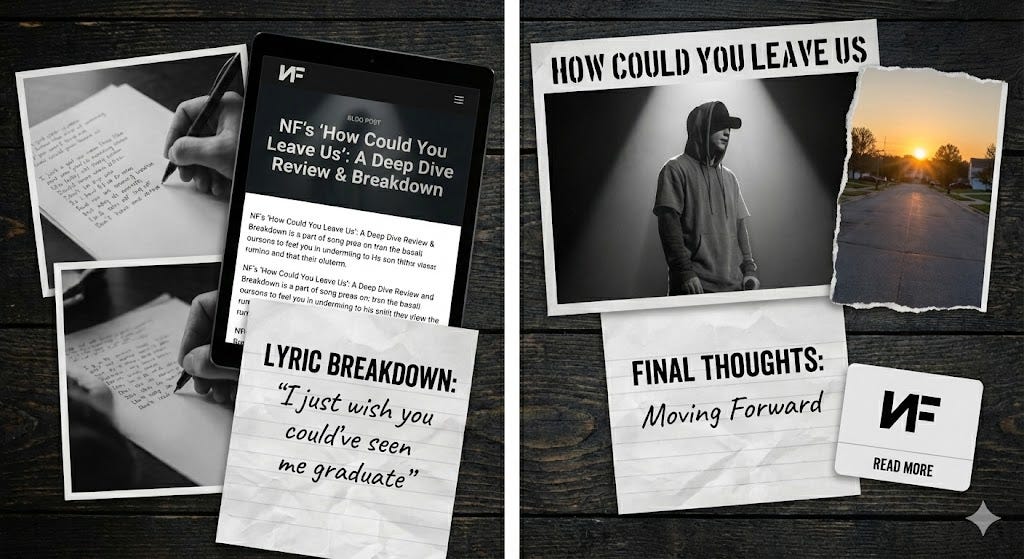
NF spits it out with zero filter:
“Mom, I’m so sorry now for what I did / When you were here, I had no idea.”
This—this is the carving knife. We all have things we wish we’d said, regrets sutured into the softer parts of memory. If you’ve ever lost someone to addiction—hell, if you were the someone—regret sticks to you, even when you know, logically, you were powerless. Even when you know it never should’ve been your job to save them.
The Anger That Burns Through the Grief
What makes “How Could You Leave Us” so brutal isn’t just the pain—it’s the rage that simmers under every single verse. NF admits it out loud.
“They say pain is a prison, let me out of my cell.”
That’s the reality of loving someone who can’t love you back the way you need—not because they don’t want to, but because addiction jacks the wiring, steals all the normal ways back home. Watching them disappear is its own kind of imprisonment.
You get mad. Some days, you get mean. You talk shit behind their back. You pray for them to wake up, or for the phone to stop ringing with bad news, or sometimes for there to be any news at all, because any news is better than not knowing if they’re frozen under a bridge or celebrating six months clean in silence. That’s what families never say at the meetings: some of us would give anything for an answer, any answer. Sometimes the worst thing is not knowing.
This anger is holy, in a way. It’s clarifying. It keeps you tethered to the world, even when everything else conspires to make you numb.
The Breakdown: Why Honest Suffering Matters
There’s a moment at the end of the track where NF’s voice cracks—and then it breaks, and then it’s gone. The first time I heard it, I sat in my car and ugly-cried until I worried someone in the Walgreens parking lot would think I’d lost it. He doesn’t clean it up or chop it out for the album—he just leaves it all there. And there’s something so ferociously human about letting the world have your grief, unfiltered.
Why does it matter? Because it makes space for realness, and realness is necessary for healing, even if it’s sloppy as hell. You can chase therapy, run twelve steps, write all the journals in the world, but if you don’t feel your grief—if you don’t let the pain chew through you—you’re just dragging the prison with you wherever you go.
NF’s public sobbing isn’t about spectacle. It’s about bearing witness to pain, letting every other wounded kid, every shamed parent, every lost soul know, “You are not alone. You are not defective. Hurt like this is proof you loved someone that could not love you the way you deserved, and that is not your fault.”
Addiction, Love, and the Shame Nobody Talks About
Let’s get clear about this: loving addiction is a dirty secret, but it’s the truth for more people than will ever admit it. The comfort, the predictable pain, the numbness. NF alludes to it, circles round and round the point—because to miss your addict parent is to miss the predator and the protector both. You need what’s killing them. Sometimes you need what’s killing you.
Nobody in polite society wants to say, “Yeah, I miss the days when I could check out, when being high or wasted made me feel more like myself, not less.” But I’ll say it. I’ll say it because the only way shame loses is when we drag it into daylight.
Shame: fuck it. I’ll take truth, no matter how ugly. Truth is the only way a person claws their way out of their own skin and into something new.
Music as Mirror, as Lifeline
Music is wired into the brains of people who hurt. It’s a trigger, sure—plenty of songs have led me back to the slippery edge. But it’s also a bridge out. NF’s art, and this song especially, hands people a way to say the things they’re not allowed to say anywhere else.
It’s more than art therapy or soundtrack. It’s honesty. It’s the most honest three minutes you’ll ever hear about growing up second to someone’s addiction. It’s the feeling of being both witness and survivor, and realizing just how many of us make up this club nobody ever wanted to join.
For the Kids at the Window and the Survivors in the Wings
I want this piece, this song, this moment, to count for something. For you, reading. For your own memories. For the little kid who learned to count cars outside the house because that’s how you track whether tonight will be safe, or violent, or worse—silent.
Here’s what I wish somebody had told me:
You don’t have to wait forever.
You do not owe your life to their sickness.
You are allowed to yearn and hate, to rage and grieve, to want the impossible and choose yourself anyway.
You can stop the cycle, even if all you have left is yourself.
NF laid his pain on the line so his audience could do something other than drown in theirs. If you listen to “How Could You Leave Us” and hear your own story, know this: it’s not just music. This is a road map, breadcrumbs out of the dark, proof that someone else survived and is still carrying on—one line, one howl, one day at a time.
So keep listening. Keep telling your story. And if you’re still waiting by the window, maybe—just maybe—it’s time to lock the door, turn up the music, and live anyway.
The Honest End: “We’re All Still Here”
Nobody gets out clean. Not from addiction, not from grief, not from loving people who just couldn’t stay. If you’re reading this and something in you is itching, aching, pissed off, or cracking open—take that as your proof you’re still alive. We’re the ones left behind, but we are here. We’re carrying the mess, carrying the music, carrying the little kid at the window around with us. And some days, that’s all survival is.
Listen: You don’t have to make it make sense. You don’t have to forgive if you’re not ready. You don’t have to heal on the timeline someone else gave you. NF’s “How Could You Leave Us” is ugly and painful and beautiful because it doesn’t tie a bow on any of it—it just sits with it. And so do I.
If nobody has told you you’re not alone, let these words, this story, and this song be the beginning. The world will try to sell you shame; refuse it. The world will try to tell you to hurry up and move on; rebel against it. If today the only thing you do is breathe and listen, I’ll call that progress. If today you can’t even do that, I’ll sit with you in the mud, music on repeat, until you can.
Where Do We Go From Here?
I want to know if this hit you. I mean, really hit you—like, “I thought I was the only one” or “I wish I had someone say this to me.” Comment, reply, send your own story. Hell, go listen to the song and scream along, or scream at me for daring to say what you barely let yourself think. This isn’t just catharsis. It’s connection.
And for the ones who are still caught somewhere between loving the broken and breaking yourself—there is another side. There’s a world beyond the waiting room. You don’t have to clean up for company. You don’t have to make yourself small so someone else can stay sick. You can choose you. No shame, no apology.
Final Note to the Little Kid at the Window (And Any Grown-Up Still Waiting There)
If all you do today is not wait—if all you do is play your song a little bit louder, or tell your truth a little bit braver—then you’re already moving. Progress is progress. NF bled out so those of us who know could recognize our own faces in the mirror. If you’re reading this, you’re part of that lineage now.
Put down the weight. Turn up the volume. Don’t waste another breath apologizing for surviving.
This is for you. For all of us.
We’re still here.
Well written! I’ve had the pleasure of speaking to NF personally and he truly is a special artist.
This felt like the music grabbing me by the collar and saying, “you’re allowed to stop waiting.”
All that mud, rage, love, shame, and stubborn survival smashed together until something honest broke through. The kid-at-the-window finally stepping away from the glass hit especially hard. Loud, messy, real — no cleanup, no apologies.
Came out of this wanting to turn it up, refuse the shame, and keep going anyway. Still here counts.